How Does the Air Permeability of PTFE High-Temperature Fabric Affect Photovoltaic Production?
The air permeability of PTFE high-temperature fabric (PTFE-coated fiberglass cloth) is a core control parameter in the photovoltaic module lamination process, directly determining encapsulation quality, yield rate, and long-term reliability. Its core impact manifests across four critical stages: degassing efficiency, encapsulant film barrier, bubble and delamination control, and power degradation.
Ⅰ. Core Application Scenario & Air Permeability Principles
PV lamination is a critical process in module manufacturing (140–160°C, vacuum environment). PTFE high-temperature fabric serves as the cushion/cover layer, and its air permeability is determined by its microscopic pore structure:
- Standard PV Lamination Fabric: Pore diameter 0.8–1.2 μm; porosity approximately 5–10%; balances degassing with penetration resistance
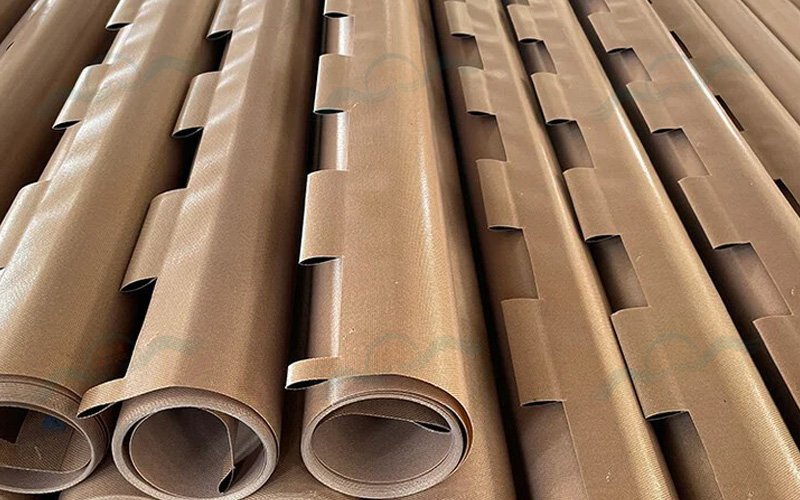
- Perforated Breathable Fabric: Pore diameter 0.5–2 mm; specifically designed for high degassing demand applications; yield rate improvement of 3%–5%
Operating Principle: Simultaneously achieves “degassing channels” and “encapsulant film barrier” — allowing rapid escape of moisture and low-molecular-weight outgassing while preventing molten EVA from penetrating into the vacuum chamber.
Ⅱ. Five Key Impacts of Air Permeability on PV Production
1. Bubble & Void Control (Most Direct Impact)
- Insufficient Air Permeability: Moisture and EVA crosslinking gases cannot escape during the initial lamination stage, forming bubbles and voids that cause localized encapsulation failure — module power output reduced by 1–3%
- Excessive Air Permeability: May cause EVA encapsulant film penetration, blocking vacuum ports or creating permanent adhesion — increasing rework and scrap rates
- Optimal Matching: Standard fabric with 0.8–1.2 μm pore diameter balances both requirements; perforated breathable fabric is recommended for high-moisture operating conditions
2. Delamination & Stratification Risk
- Poor air permeability → gas retention → insufficient interlayer bonding strength → long-term delamination; accelerates moisture ingress; triggers PID (Potential-Induced Degradation)
- Non-uniform air permeability → localized pressure differentials → warpage and delamination; compromises module sealing integrity; shortens the 25-year service life
3. Power Degradation & Long-Term Reliability
- Bubbles/delamination → non-uniform light absorption → hot spot effect in solar cells → accelerated power degradation; annual degradation rate increases from 0.5% to above 1.5%
- Poor degassing → residual decomposition products of encapsulant materials → yellowing and reduced light transmittance; module photo-electric conversion efficiency reduced by more than 0.18%
4. Production Efficiency & Cost
- Insufficient air permeability → extended degassing time → single module lamination cycle increases by 10–20 seconds; production line capacity reduced by 5–10%
- Poor air permeability → frequent pore blockage and fabric replacement → increased maintenance downtime costs; overall yield rate reduced by 3–8%
5. Surface Quality & Optical Performance
- Non-uniform air permeability → uneven module surface → light scattering losses increase by 0.1–0.3%; power generation reduced
- Premium breathable fabric (double-sided smooth surface, uniform porosity) → consistent surface finish → improves module appearance and optical performance
Ⅲ. Selection & Control Recommendations
| Influencing Factor | Recommended Parameters | Applicable Scenarios |
|---|---|---|
| Porosity | 5–10% | Standard crystalline silicon module lamination |
| Pore Diameter | 0.8–1.2 μm | Standard lamination process |
| Perforation Density | 50–100 perforations/cm² | High-moisture / thick backsheet module applications |
| Coating Process | High-density PTFE coating | EVA penetration prevention; extended service life |
| Thickness | 0.30–0.35 mm | Compatible with mainstream laminating machines |
Ⅳ. Summary
The air permeability of PTFE high-temperature fabric is an invisible regulatory parameter in the PV lamination process. Greater air permeability is not inherently better — precise matching to process requirements (module type, EVA grade, vacuum level) is essential to achieve the optimal balance of degassing efficiency, penetration resistance, and surface quality. This ultimately ensures high reliability and low degradation throughout the module’s 25-year service lifecycle.