How to Correctly Use PTFE Teflon Tape to Ensure Its Temperature Resistance Performance?
Ensuring the temperature resistance performance of PTFE tape centers on five key areas: selecting the right product, proper surface preparation, standardized installation, controlling operating temperature and environment, and regular maintenance. PTFE tape has a long-term temperature resistance limit of 260°C, short-term tolerance of 300°C, and a thermal decomposition temperature of approximately 400°C — correct usage fully maximizes its high-temperature performance advantages.
Ⅰ. Pre-Application Preparation: Select the Right Product & Clean the Surface
1. Select the Appropriate PTFE Tape
| Type | Temperature Range | Applicable Scenarios |
|---|---|---|
| Pure PTFE Film Tape | -196°C to 260°C (short-term 300°C) | Light-load, low-tack applications |
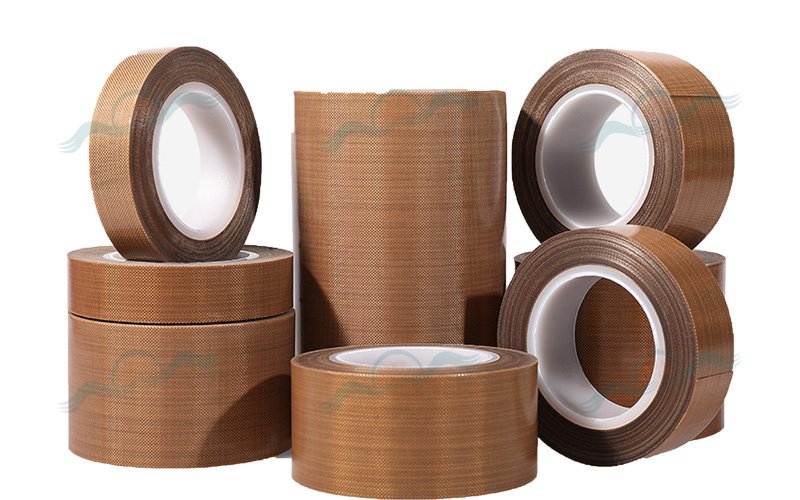
| Fiberglass-Based PTFE Tape | -196°C to 260°C (short-term 300°C) | High-strength, wear-resistant, high-temperature heavy-duty applications |
| Silicone PSA PTFE Tape | -60°C to 260°C | High-temperature applications requiring adhesive fixation |
| Anti-Static PTFE Tape | -196°C to 260°C | Electronics, chemical processing, and other anti-static applications |
Key Notes:
- Avoid purchasing recycled material or substandard products — their temperature resistance may be significantly reduced and may release harmful substances at high temperatures
- Verify product certification: always select products from reputable suppliers with clear temperature ratings and quality certifications
2. Thoroughly Clean the Bonding Surface (One of the Most Critical Steps)
- Remove all oil, grease, dust, metal filings, and rust — these compromise adhesive tack and cause adhesive failure at high temperatures
- Cleaning method: Sand down burrs and rough edges, wipe with alcohol or acetone, then dry with a clean cloth — ensure the surface is dry, smooth, and contaminant-free
- For rough surfaces such as cast iron, additional grinding to achieve flatness is required; Sa2.5 blasting standard may be necessary where applicable
Ⅱ. Standardized Installation: Ensure Tight Adhesion & Defect-Free Application
1. Cutting & Preparation
- Cut tape approximately 5 cm longer than required to avoid edge imperfections affecting adhesion
- Keep the release liner in place until application — premature removal causes tape curling and dust contamination
2. Application Process (Core Steps)
- Peel-as-you-go method: Never remove the entire release liner at once — prevents tape deformation and bubble formation
- Apply uniform pressure: Use a clean cloth or paper to firmly press and smooth the applied tape, ensuring complete surface contact with no air entrapment
- Heat gun assistance: For complex surfaces or areas requiring stronger adhesion, apply gentle heat from a heat gun (80–120°C) to tape edges to improve extensibility and surface conformability
Joint/Seam Treatment:
- Overlap width ≥ 20 mm to prevent heat ingress through gaps
- Apply PTFE repair compound at joints to enhance sealing integrity and high-temperature resistance
Thread Sealing Special Requirements (Thread Seal Tape Application):
- Wind clockwise (in the same direction as thread tightening); begin applying tension from the second thread
- Control winding layers (4–6 layers recommended) — excessive thickness prevents full thread engagement
- Never extend tape beyond the first thread — prevents loosening during assembly
3. Fixation & Inspection
- For complex structures or high-temperature vibration applications, use clamps for additional fixation for 24 hours to ensure full adhesive curing
- Post-installation inspection: confirm no bubbles, wrinkles, or edge lifting; edges must be tightly bonded
Ⅲ. Usage Control: Temperature Management & Environment Optimization
1. Strict Operating Temperature Control
- Continuous operating temperature ≤ 260°C — the stable working range of PTFE tape
- Short-term high temperature ≤ 300°C, with duration not exceeding 30 minutes — prevents performance degradation
- Open flame contact is absolutely prohibited — even though PTFE is heat-resistant, direct flame contact instantaneously exceeds the thermal decomposition temperature
- For applications with large temperature fluctuations, maintain a 20–30°C safety margin below the rated limit
2. Avoid Adverse Environmental Conditions
- Keep away from strong acids, strong alkalis, and strong oxidizing agents — while PTFE itself is corrosion-resistant, the adhesive layer may be affected
- Prevent sharp objects from scratching the tape surface — damage to the PTFE film layer reduces high-temperature resistance
- Avoid prolonged UV exposure — accelerates tape aging and reduces thermal service life
Ⅳ. Maintenance — Extending High-Temperature Service Life
Regular Inspection:
- High-temperature applications: inspect weekly; standard applications: inspect monthly
- Key inspection points: adhesive failure, edge lifting, bubble formation, discoloration; joint integrity and signs of heat leakage
Cleaning & Maintenance:
- Periodically wipe tape surface with a damp cloth to remove dust and contaminants; maintain a dry, clean surface
Timely Replacement:
- Replace immediately upon detection of aging, cracking, or performance degradation
- For continuous operation near 260°C, replacement every 6–12 months is recommended
Correct Storage:
- Store unused tape in a cool, dry location at 0–25°C; avoid direct sunlight and high-temperature environments
Ⅴ. Common Mistakes & Solutions
| Common Mistake | Impact | Solution |
|---|---|---|
| Using recycled material or substandard tape | Reduced temperature resistance; releases harmful substances at high temperature | Select reputable brands; verify product certification |
| Incomplete surface cleaning | Adhesive failure and sealing failure at high temperature | Wipe with alcohol/acetone; ensure oil-free and dry surface |
| Removing entire release liner at once | Tape curling and bubble formation | Peel-as-you-go; use cloth to press down |
| Sustained over-temperature operation (> 260°C) | Accelerated aging; performance degradation | Control temperature; maintain safety margin |
| Direct open flame contact | Thermal decomposition; toxic gas release | Avoid open flame; use thermal insulation protective layer |
Ⅵ. Summary: Core Requirements for Ensuring Temperature Resistance Performance
- Select the appropriate PTFE tape — confirm the 260°C continuous temperature rating
- Surface preparation: oil-free, contaminant-free, dry, and smooth
- Installation: peel-as-you-go, apply uniform pressure, use heat gun assistance — achieve bubble-free bonding
- Strict temperature control: continuous ≤ 260°C; short-term ≤ 300°C; never allow open flame contact
- Regular inspection and maintenance; replace aged tape promptly