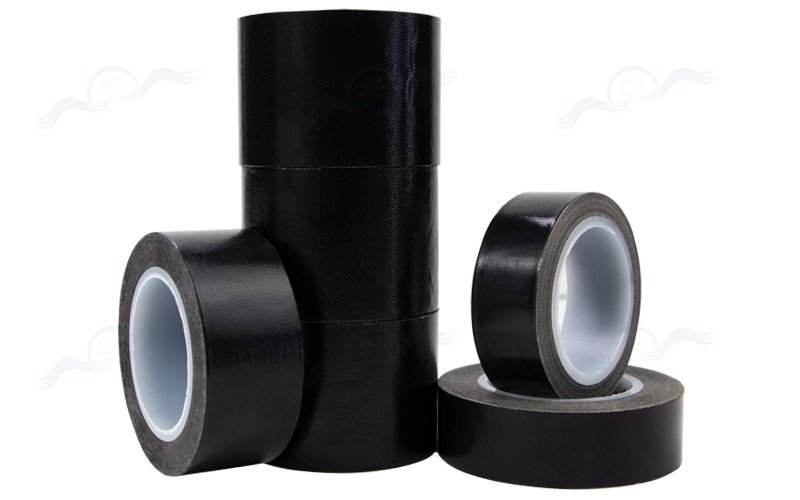
What Factors Are Related to the Service Life of PTFE Teflon Tape?
The service life of PTFE tape is not a fixed value — ranging from months to years. It is primarily influenced by four categories of factors: product material and manufacturing quality, operating environment, actual application conditions, and installation/maintenance practices. Among these, friction and wear, temperature, and adhesive bonding strength are the three most critical core factors.
一、产品材料与制造质量(基础决定因素)
Substrate Type & Quality
PTFE 胶带有纯 PTFE 基材和玻璃纤维增强 PTFE 基材等级。玻璃纤维增强型在 PTFE 涂层内嵌入玻璃纤维网状结构,显著提升了耐磨性、抗撕裂性和抗拉强度——这是工业应用的标准,使用寿命比纯 PTFE 基材长 2–5×。涂层厚度也影响使用寿命:较厚的涂层(≥50 微米)提供更高的抗摩擦能力;薄涂层(≤20 微米)容易被磨损穿透。
Adhesive Layer Performance & Bonding Strength
The adhesive layer is critical to bonding between tape and substrate. Mainstream options include silicone rubber adhesive (excellent temperature resistance, rated -60°C to 260°C) and acrylic adhesive (strong tack at ambient temperature, only rated to approximately 80°C). Adhesive layer thickness, bonding strength, and chemical resistance directly affect detachment risk — poor adhesion or susceptibility to corrosion causes premature edge lifting and delamination, abruptly ending service life. Premium tape features tightly integrated adhesive and substrate layers that resist delamination.
Manufacturing Process Quality
Coating uniformity, substrate-adhesive lamination quality, and edge cutting precision all affect service life: non-uniform coating wears through first at thin spots; poor lamination causes substrate-adhesive delamination; rough-cut edges are prone to tearing and edge lifting.
Ⅱ. Operating Environment Factors (Primary External Aging Drivers)
Operating Temperature
The long-term thermal limit of the PTFE substrate is 260°C; short-term tolerance up to 300°C. Sustained over-temperature operation (e.g., continuously above 280°C) causes gradual substrate aging and hardness reduction, and adhesive softening/delamination. Below -60°C, silicone rubber adhesive becomes brittle and tack drops sharply. Sudden thermal cycling (rapid heating/cooling) is particularly damaging — the different thermal expansion coefficients of substrate and adhesive create micro-gaps at their interface, allowing moisture and dust ingress, ultimately causing delamination and edge lifting.
Chemical Media & Humidity
PTFE substrate resists most acids, alkalis, organic solvents, and oils — but the adhesive layer does not share these properties. Strong solvents (acetone, toluene) and concentrated strong acids/alkalis corrode silicone/acrylic adhesive layers, causing failure. High humidity (relative humidity > 85%) or prolonged water/steam contact reduces adhesive bonding strength — especially when the substrate surface has gaps. Outdoor UV exposure causes photo-aging of the adhesive layer, with gradual tack loss — outdoor applications require UV-resistant additive-enhanced PTFE tape.
Dust & Contaminant Particles
In dusty environments, fine particles penetrate the gap between tape and substrate, or adhere to the tape surface — reducing bonding strength and causing abrasive wear that accelerates PTFE coating degradation.
Ⅲ. Actual Application Conditions (Most Direct Wear Factors)
Friction & Wear Intensity
This is the most critical operating condition factor. For applications involving continuous friction with materials or equipment (rollers, conveyor belts, heat sealers):
- Material characteristics: Hard particles and abrasive materials (sand, powder metallurgy materials) cause far greater friction loss than soft, smooth materials; adhesive materials (adhesives, plastic pellets) require scraping during cleaning, which damages the PTFE coating
- Friction speed and pressure: High-speed, high-pressure friction raises surface temperature and accelerates coating wear — high-speed roller conveying wears 3–10× faster than low-speed intermittent friction
Mechanical Stress
Sustained tensile, compressive, or shear forces cause rapid failure: over-stretching cracks the PTFE substrate and separates it from the adhesive; edge tearing (from material snagging) is the most common cause of edge lifting — once initiated, the gap expands rapidly and the tape eventually detaches completely; prolonged compression deforms the adhesive and reduces tack.
Frequency of Use
Continuous 24-hour operation causes constant aging and wear of substrate and adhesive — service life is far shorter than intermittent use. For example: heat sealer intermittent use (several hours per day) achieves 1–2 years service life; continuous-duty roller conveyor belts may last only 3–6 months.
Ⅳ. Installation & Maintenance Practices (Human-Controllable Key Factors)
Pre-Installation Surface Preparation
Oil, dust, rust, or moisture on the roller, metal plate, or substrate surface reduces adhesive bonding strength by over 80%, causing subsequent edge lifting and detachment. The surface must be cleaned with alcohol or acetone and allowed to dry completely before application.
Application Quality
Bubbles, wrinkles, or excessively wide splice gaps during application allow moisture and dust ingress, causing localized adhesive failure. Wrinkled areas experience uneven stress, prone to cracking. Splice gaps become edge-lifting initiation points.
Edge & Sealing Treatment
Tape edges are the weakest point. Without edge sealing treatment (e.g., PTFE edge sealing adhesive or high-temperature tape wrapping), edges are vulnerable to material snagging and moisture attack — once edge lifting begins, degradation accelerates rapidly.
Routine Maintenance
Promptly clean adhesive materials and dust from the tape surface; avoid direct hard-tool scraping (use soft cloth + specialized cleaning agent). Regularly inspect tape condition — address small areas of edge lifting or wear promptly through repair or localized replacement to prevent problems from escalating.
Ⅴ. Service Life Reference by Application Scenario (Fiberglass-Reinforced Premium Grade)
- Ambient temperature, dry, friction-free sealing/insulation: 3–5 years or longer
- Medium temperature (< 150°C), light friction (e.g., food packaging heat sealer): 1–2 years
- High temperature (200–260°C), medium friction (e.g., plastic bag-making machine roller): 6–12 months
- High temperature, high friction, abrasive material conveying (e.g., mining, building materials roller): 3–6 months
Core Tips for Extending PTFE Tape Service Life
- Select by application: High-temperature/high-friction → fiberglass-reinforced PTFE + silicone adhesive; outdoor → UV-resistant grade
- Standardize installation: Thoroughly clean surface; apply without bubbles or wrinkles; seal edges
- Reduce wear: In high-friction scenarios, apply anti-wear coating to tape surface or use wear-resistant guide plates to reduce direct material-to-tape friction
- Regular maintenance: Timely cleaning and repair; prevent small issues from escalating