What Are the Methods for Repairing PTFE High-Temperature Fabric?
Repair methods for PTFE high-temperature fabric are selected based on the type and extent of damage. The core principle is to restore the PTFE coating’s continuity and functionality while ensuring the repair is compatible with the original material’s temperature and chemical resistance properties.
Ⅰ. Common Damage Types & Repair Method Matching
| Damage Type | Description | Recommended Repair Method |
|---|---|---|
| Surface scratches (no coating penetration) | Shallow coating wear, no substrate exposure | PTFE coating repair spray / high-temperature release coating touch-up |
| Localized coating wear-through | Substrate exposed; area < 50 cm² | PTFE adhesive patch repair / PTFE film bonding |
| Edge tearing | Edge cracking or tearing ≤ 50 mm | Edge trimming + re-sealing + PTFE tape edge banding |
| Large area damage | Damage area > 50 cm² or structural damage | Section replacement + heat-weld splicing |
| Splice joint failure | Heat-weld joint debonding or mechanical fastener failure | Joint re-welding / replacement of mechanical fasteners |
Ⅱ. Specific Repair Methods
Method 1: PTFE Coating Repair Spray (Suitable for Surface Scratches)
Applicable Damage: Shallow surface coating wear; no substrate exposure; Ra value increased; slightly reduced non-stick performance
Materials: PTFE release coating spray (temperature rating ≥ 260°C); fine-grit sandpaper (800–1,000 grit); alcohol wipes
Procedure:
- Clean the repair area thoroughly with alcohol; ensure surface is free of oil, grease, and contaminants
- Lightly sand the surrounding damaged area (to improve adhesion of repair coating)
- Apply PTFE spray in thin coats (2–3 coats; allow each coat to flash off before applying the next)
- Cure at 200–260°C for 20–30 minutes (use oven or heat gun)
- Inspect repaired surface: roughness and non-stick performance should return to near-original levels
Limitations:
- Repair layer is thin; durability is limited — not suitable for high-friction scenarios
- Only suitable for minor surface scratches; cannot repair coating wear-through
Method 2: PTFE Film Adhesive Patch Repair (Suitable for Localized Coating Wear-Through)
Applicable Damage: Substrate exposed; damage area < 50 cm²; structural integrity of original fabric is maintained
Materials: PTFE film (same thickness as original; temperature rating ≥ 260°C); high-temperature PTFE adhesive (e.g., fluoroelastomer adhesive; rated 260°C); high-temperature pressure-sensitive silicone tape (for temporary fixation)
Procedure:
- Cut damage area edges neatly; remove loose fibers and contamination; wipe with alcohol
- Cut a PTFE film patch slightly larger than the damage area (extend 10–15 mm beyond all edges)
- Apply high-temperature PTFE adhesive to both the patch underside and the repair area (thin, uniform coat)
- Position the patch and press firmly; use high-temperature tape for temporary fixation
- Apply heat curing: heat press at 180–220°C for 15–30 minutes under 0.3–0.5 MPa pressure (or use oven if heat press is unavailable; clamp with weight)
- After cooling, inspect edges: no lifting or bubbles; the repaired area must be flush with the surrounding surface
Limitations:
- Adhesive layer may limit repair temperature resistance (typically 220–260°C); verify with manufacturer
- Patch edges are weak points; not recommended for high-tension scenarios (tensile force concentration at patch edges may cause peeling)
Method 3: Heat-Weld Splicing Repair (Suitable for Large Damage Areas or Structural Damage)
Applicable Damage: Large damage area (> 50 cm²), structural fabric damage, or major tears
Equipment: PTFE heat press machine or PTFE heat welding machine (temperature-controllable up to 350°C); heat-resistant release paper (prevents sticking during pressing)
Procedure:
- Cut away all damaged material cleanly (straight-line cutting; ensure smooth edges)
- Cut a new PTFE fabric patch of matching size and thickness; allow 20 mm overlap on all sides
- Place the patch on the damaged area with overlapping edges; insert heat-resistant release paper above and below to prevent sticking to the press platens
- Apply heat and pressure (welding temperature: 280–320°C; pressure: 0.5–1.0 MPa; hold time adjusted based on thickness: typically 3–8 minutes)
- Slowly release pressure and allow to cool naturally to below 100°C before removing
- Inspect weld quality: cross-section should show even fusion bonding with no delamination; strength should be ≥ 75% of parent material
Notes:
- Requires professional heat press equipment; not suitable for field repairs
- After heat welding, the repair area has slightly different color from the parent material (normal — not a defect)
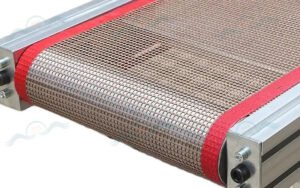
- For conveyor belt structural repairs, re-verify belt tension and tracking after repair
Method 4: Edge Repair (Suitable for Edge Tearing)
Applicable Damage: Belt edge tearing ≤ 50 mm; no structural damage
Materials: PTFE tape (self-adhesive; same thickness as parent material; width 20–30 mm); or Kevlar thread + PTFE film combination
Procedure:
- Trim torn edges with scissors; cut away all frayed fibers
- Fold PTFE tape over the edge (cover both front and back surfaces; extend 10–15 mm beyond the tear on each side)
- Apply heat press (180–200°C; 5–10 minutes) to bond edge tape to the parent fabric
- Optional: apply a bead of high-temperature edge sealant at the edge for additional protection
Method 5: Splice Joint Re-Welding (Suitable for Heat-Weld Joint Failure)
Applicable Damage: Heat-weld joint debonding, cracking, or delamination
Procedure:
- Cut away the old failed joint completely
- Re-cut new flat joint faces (perpendicular to belt centerline; angular deviation ≤ 0.5°)
- Re-weld using the standard heat welding procedure
- Post-weld inspection: joint flatness deviation ≤ 0.2 mm; peel strength ≥ 75% of parent material
Ⅲ. When to Repair vs. Replace — Decision Criteria
| Condition | Recommendation |
|---|---|
| Surface scratches; non-stick performance slightly reduced | Spray repair; continue service |
| Localized wear-through; area < 50 cm²; good structural integrity | Patch repair; monitor closely |
| Large damage area (> 50 cm²) or structural fracture | Section replacement + heat-weld |
| Multiple damage points; cumulative area > 20% of total belt area | Full belt replacement recommended |
| Belt elongation deformation (length increase > 1%) or widespread delamination | Full belt replacement required |
Ⅳ. Post-Repair Verification
After any repair, the following must be verified before returning to service:
- Appearance inspection: No edge lifting, bubbles, or color anomalies
- Adhesion test: Peel back repair area by hand with moderate force — no delamination
- Dimensional check: Repair area thickness consistent with surrounding fabric (tolerance ± 0.05 mm)
- Trial run: No-load operation for 30 minutes — check tracking stability and whether repair area exhibits abnormal wear
Tags: