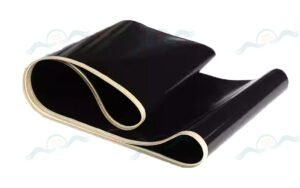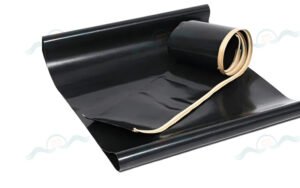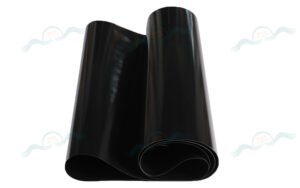
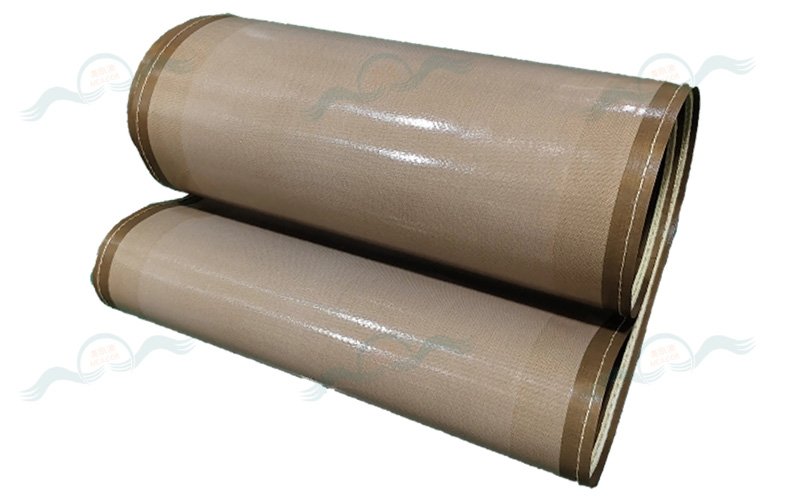
PTFE (Teflon) high-temperature fabric, as the core substrate material for high-temperature conveyor belts, is undergoing comprehensive innovation across three dimensions — material compositing, process upgrading, and functional integration — fully adapting to the stringent demands of continuous industrial production lines in lithium battery, photovoltaic, semiconductor, food, and pharmaceutical manufacturing. It has become the preferred solution to replace traditional rubber and metal conveyor belts in high-temperature operating conditions.
Ⅰ. Core Performance — The Foundation for Continuous Production
| Performance Dimension | Key Parameters | Value for Continuous Production Lines |
|---|---|---|
| Ultra-Wide Temperature Range | Long-term: -70°C to 260°C; short-term: 300°C; premium grades: up to 360°C | Accommodates multi-process temperature variations; ensures stable 24-hour operation |
| Thermal Stability | 250°C continuous 200 days: strength retention ≥ 95%; 350°C/120h: weight loss ≤ 0.6% | Reduces thermal aging-related downtime; extends service life 3–5× |
| Non-Stick Performance | Low surface energy; friction coefficient 0.05–0.1 | Prevents material adhesion; reduces cleaning frequency; lowers defect rate |
| Chemical Corrosion Resistance | Resistant to strong acids, strong alkalis, aqua regia & organic solvents | Suitable for chemical processing & electroplating corrosive environments; prevents belt damage |
| High Strength & Low Elongation | Tensile strength ≥ 4,800 N/5cm; longitudinal elongation < 1% | Ensures dimensional stability at high speed; prevents belt tracking deviation |
Ⅱ. Key Innovation Technologies — The Core Drivers Breaking Traditional Limitations
1. Material Composite Innovation
- Nano-Modified Reinforcement: Graphene and boron nitride nanoparticle doping improves wear resistance (+40%) and thermal conductivity (+30%) — suitable for higher line speeds and thermal load conditions
- Gradient Functional Structure: High-wear-resistance PTFE surface layer + thermally conductive filler intermediate layer + reinforced fiber base layer — meeting micron-level thermocompression requirements of precision processes
- Substrate Upgrading: Expanded from fiberglass to Kevlar and carbon fiber composites; tensile strength improved 2–3×; suitable for heavy-load continuous conveying
2. Process Innovation Breakthroughs
- Seamless Integrated Forming: Annular weaving + integral sintering process eliminates traditional splice joint breakage risk; service life improved by 50%; suitable for high-speed precision production lines
- Precision Coating Technology: Multi-pass impregnation + gradient baking + 360°C continuous sintering; coating uniformity achieved at ±0.01 mm; ensures uniform material heat exposure
- Functional Post-Treatment: Anti-static treatment (surface resistance < 10⁶ Ω), non-stick coatings, and antimicrobial treatment — tailored for electronics, food, and other specialized industries
3. Intelligent Integration Upgrades
- Embedded Sensors: Integrated temperature, pressure, and wear monitoring modules enable predictive maintenance and reduce unplanned downtime
- Data Connectivity Interface: MES system integration provides real-time conveyor belt status feedback for optimized production line scheduling
Ⅲ. Core Solutions for Continuous Production Line Adaptation
1. Production Line Adaptation Design Strategies
- Modular Assembly: Customized straight, curved, and inclined configurations tailored to production line layouts — accommodating complex conveying paths
- Width Customization: Full coverage from 50 mm to 5,000 mm; extra-wide configurations use double-weft weaving technology to prevent edge tearing
- Interface Optimization: Precision matching with drive drums and tensioning devices; reduces friction losses; lowers energy consumption by 30%
2. Key Industry Application Cases
| Industry | Application Scenario | PTFE Fabric Solution | Production Line Value |
|---|---|---|---|
| Lithium Battery | Electrode foil drying, separator forming | Ultra-thin (0.05 mm) + anti-static coating; bending radius < 3 mm | Yield rate improved to 99.5%; energy consumption reduced by 25% |
| Photovoltaics | Solar cell drying, module lamination | Low outgassing + high cleanliness grade; withstands 150°C vacuum environment | Eliminates EVA film adhesion; module service life extended by 10 years |
| Semiconductor | Wafer baking, packaging thermocompression | Micron-level flatness + low metal ion migration | Meets Class 100 cleanroom requirements; yield rate improved by 5% |
| Food & Pharma | Baking tunnels, sterilization conveying | Food-grade certified + antimicrobial coating; withstands 200°C | GMP compliant; cleaning time reduced by 60% |
3. Continuous Operation Assurance System
- Simplified Maintenance: Strong self-cleaning surface requires only high-pressure water rinsing; maintenance downtime reduced by 80%
- Service Life Extension Measures:
- Use transition rollers at concave transition points to prevent startup tearing
- Improve chute design with cushioning baffles
- Regular tension monitoring to prevent tracking deviation and wear
- Rapid Replacement System: Modular design + dedicated splicing tools; replacement time reduced from 4 hours to 30 minutes
Ⅳ. Innovation Value — The Efficiency Multiplier for Continuous Production Lines
Total Lifecycle Cost Reduction: Service life reaches 1.5–2 years (vs. traditional rubber belts: only 6–12 months); maintenance costs reduced by 70%
- Throughput Improvement: Downtime reduced by 30%; compatible with higher line speeds (up to 10 m/s); production capacity improved by 25%
- Product Quality Optimization: Smooth seamless surface ensures uniform material heat exposure; defect rate reduced by more than 50%
- Environmental & Energy Efficiency: Low friction coefficient reduces energy consumption; zero VOC emissions; compliant with carbon neutrality strategies
Ⅴ. Future Trends — Advancing Toward Higher-End Continuous Production Adaptation
- Ultra-High-Temperature Extension: Ceramic fiber composites targeting temperature resistance breakthrough to 400°C — suitable for metallurgy, glass, and other extreme operating conditions
- Lightweighting & Ultra-Thin Development: Thickness reduced to 0.03 mm — suitable for precision processes such as microchip packaging
- Bio-Based Material Integration: Development of biodegradable PTFE composite mesh belts in response to green manufacturing requirements
- Intelligent Autonomy: AI algorithm-integrated self-diagnostic systems enabling conveyor belt fault prediction and automatic adjustment
Summary
Through comprehensive innovation in materials, processes, and functionality, PTFE high-temperature fabric has evolved from a mere “alternative” to traditional high-temperature conveyor belts into a core enabler of continuous industrial production lines. Selecting the right PTFE high-temperature conveyor belt requires evaluating key parameters including production line temperature, material characteristics, and line speed requirements — with priority given to advanced technology solutions such as seamless construction and nano-modified materials — to achieve dual improvements in production line efficiency and product quality.