How to Select the Right PTFE Teflon Tape for Specific Low-Temperature Environments?
Selecting the right PTFE tape for a specific low-temperature environment centers on two critical points: the tape’s low-temperature tolerance limit and the adhesive layer’s low-temperature stability (the PTFE substrate itself is inherently low-temperature resistant, but the adhesive is the weak link). The following provides a step-by-step selection guide covering key parameters, scenario matching, and common pitfalls.
Step 1: Define the Core Low-Temperature Environment Parameters
Lock in 3 baseline factors that directly determine whether the tape can survive:
- Minimum Operating Temperature: -40°C, -70°C, or lower (e.g., liquid nitrogen environment at -196°C)?
- Duration of Low-Temperature Exposure: Short-term (hours) or long-term (months/years)?
- Combined Environment: Is low temperature accompanied by chemical corrosion, UV exposure, vibration, or moisture (e.g., outdoor low-temp + rain/snow, industrial low-temp + solvents)?
Step 2: Select by Adhesive Type — The Core Low-Temperature Performance Layer
90% of PTFE tape’s cold resistance is determined by the adhesive. The PTFE substrate (pure film or fiberglass cloth) itself withstands -200°C or lower — no concern needed there. Adhesive cold resistance ranking:
| Adhesive Type | Low-Temp Tolerance | Core Advantages | Applicable Scenarios | Pitfall Warning |
|---|---|---|---|---|
| Silicone Adhesive | -70°C to -100°C (select grades reach liquid nitrogen -196°C) | Low-temp resistant + weatherproof + chemically resistant; no embrittlement or tack loss at low temp | Ultra-low-temp (below -50°C), long-term outdoor low-temp, LNG pipeline sealing, aerospace low-temp components | Higher cost; slightly lower initial tack; some grades require heat activation (40–60°C) |
| Acrylic Adhesive | -40°C to -20°C | Low cost; good initial tack; stable at ambient temperature | Standard low-temp (-20°C to -40°C), indoor low-temp packaging/insulation, short-term low-temp use | Prone to embrittlement and sudden tack loss below -40°C; long-term low-temp use causes debonding |
| Rubber-Based Adhesive | -30°C to 0°C | Extremely strong initial tack; soft and easy to apply | Ambient to light low-temp (above 0°C), temporary fixation | Rapidly hardens and debonds at low temperatures; not recommended below -20°C |
Key Conclusions:
- Ultra-low temperatures below -50°C: Silicone adhesive PTFE tape is mandatory (prioritize grades labeled “liquid nitrogen rated” or “-100°C stable”)
- Standard low-temperature range (-20°C to -40°C): Acrylic adhesive (cost priority) or silicone adhesive (stability priority) are both acceptable
- Mild low-temperature above 0°C: Acrylic or rubber-based adhesive both work; select based on cost-performance ratio
Step 3: Match Substrate Type to Low-Temperature Application Requirements
PTFE tape substrates fall into 3 categories, with significant differences in low-temperature flexibility, strength, and wear resistance:
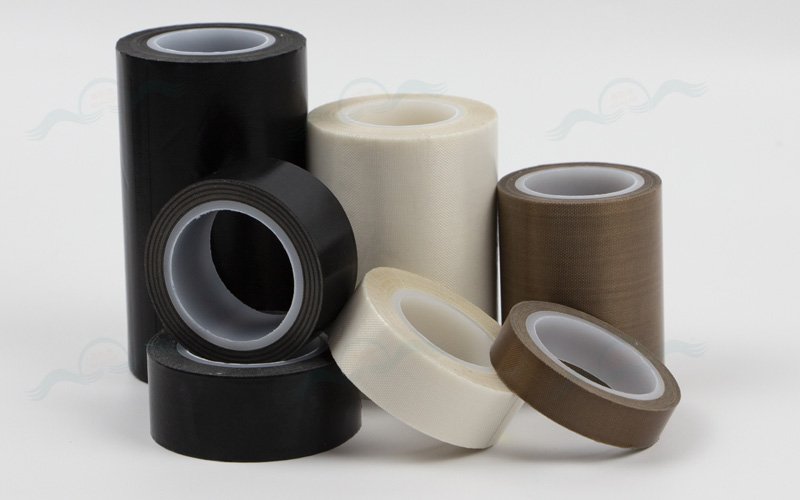
1. Fiberglass Cloth Substrate (Most Common)
- Characteristics: Fiberglass composite in PTFE film delivers high strength, tear resistance, and wear resistance at low temperatures; resists brittle fracture
- Applications: Low-temperature pipeline wrapping, equipment sealing, roller anti-stick (load-bearing/wear-resistant applications), outdoor low-temperature component fixation
- Thickness Recommendation: 0.13–0.25 mm for low-temperature environments (too thin = brittle; too thick = poor curved surface conformability)
2. Pure PTFE Film Substrate
- Characteristics: No fiber reinforcement; extremely flexible and thin (0.05–0.10 mm); suitable for curved surfaces and precision components; slightly lower tear resistance at low temperatures
- Applications: Low-temperature electronic insulation (sensors, circuit boards), precision instrument sealing, small component wrapping
- Note: For ultra-low temperatures (below -70°C), select thicker grades (≥ 0.08 mm) to prevent brittle fracture
3. Non-Woven / Polyester Substrate (Rare)
- Characteristics: Low cost but prone to shrinkage and poor strength at low temperatures; only suitable for ambient to 0°C light low-temperature use — not recommended below -20°C
Step 4: Refine Selection Based on Functional Requirements
Beyond cold resistance, core functional requirements at low temperatures must also be matched:
1. Low-Temperature Sealing / Leak Prevention (e.g., Pipelines, Valves)
- Required: Silicone adhesive + fiberglass cloth substrate (low-temp resistant + good sealing + pipeline vibration resistance)
- Additional: Select high-tack grade (low-temperature tack ≥ 5 N/25 mm; verify manufacturer specs) to prevent debonding and leakage
2. Low-Temperature Anti-Stick (e.g., Cryogenic Rollers, Molds)
- Core: PTFE surface anti-stick properties are unaffected by low temperatures; focus on preventing adhesive layer detachment
- Recommended: Silicone adhesive + fiberglass cloth substrate (wear-resistant + cold-resistant; suitable for continuous roller operation)
3. Low-Temperature Electrical Insulation (e.g., Electronic Components, Cables)
- Required: Pure PTFE film substrate + silicone adhesive (thin + stable insulation; dielectric performance does not degrade at low temperatures)
- Thickness: 0.05–0.10 mm; avoid excessive thickness that impedes component heat dissipation
4. Outdoor Low-Temperature + Weatherproof (e.g., PV Systems, Outdoor Equipment)
- Required: Silicone adhesive + fiberglass cloth substrate (low-temp resistant + UV resistant + rain/snow resistant; long-term without aging)
- Pitfall: Never select acrylic adhesive (outdoor low-temp + UV causes powdering and debonding)
Step 5: Always Verify Manufacturer Technical Parameters — Don’t Trust Advertising Claims Alone
Check 3 key indicators from manufacturers for more reliable selection:
- Brittle Temperature: Lower is better (silicone adhesive typically ≤ -70°C; acrylic ≤ -40°C)
- Low-Temperature Tack: ≥ 3 N/25 mm at -40°C; ≥ 2 N/25 mm at -70°C (prevents cold-temperature tack failure)
- Low-Temperature Holding Power: No displacement after 24 hours with 500 g weight at -40°C (verifies long-term stability)
Pitfall Warnings: 3 Common Mistakes
- Focusing only on “PTFE is cold-resistant” while ignoring the adhesive: PTFE withstands -200°C, but the adhesive may debond at -30°C — rendering the tape completely ineffective
- Selecting thin pure PTFE film for ultra-low temperatures: Pure film below -70°C is prone to brittle fracture — fiberglass cloth substrate or thick pure film is mandatory
- Applying tape directly in cold conditions: Silicone and acrylic adhesives have poor initial tack at low temperatures — pre-warm the bonding surface to 40–60°C during application, press firmly after application, and allow 24 hours at ambient temperature before transferring to low-temperature environment
Quick Selection Formula
- Ultra-low temp (below -50°C): Silicone adhesive + fiberglass cloth substrate + thickness ≥ 0.13 mm
- Standard low-temp (-20°C to -40°C): Acrylic (cost) / Silicone (stability) + select substrate as needed
- Precision low-temp insulation: Silicone adhesive + pure PTFE film substrate (0.08–0.10 mm)
- Outdoor low-temp: Silicone adhesive + fiberglass cloth substrate (UV resistant + cold resistant)