How to Test the Temperature Resistance Performance of PTFE High-Temperature Fabric?
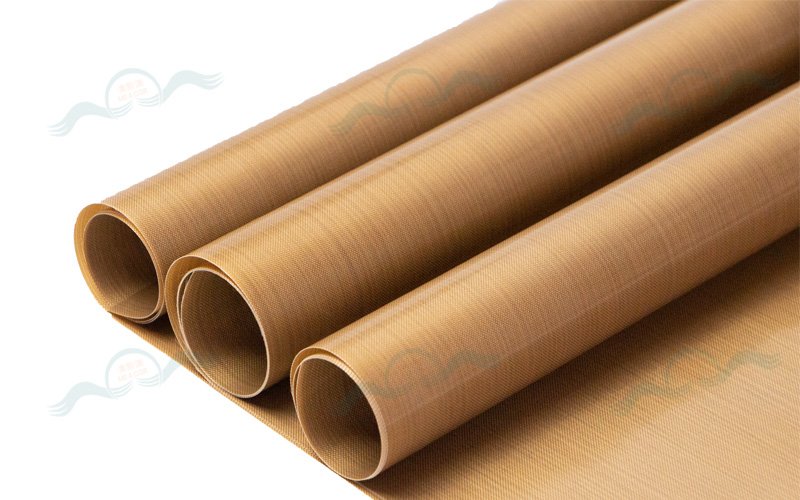
Testing the temperature resistance of PTFE high-temperature fabric follows a three-step core sequence: first test the ultimate decomposition temperature, then test long-term operating temperature resistance, and finally verify performance through simulated actual operating conditions — covering both laboratory standard testing and engineering application scenarios. PTFE high-temperature fabric consists of a PTFE coating + fiberglass substrate; temperature resistance depends primarily on PTFE thermal stability, coating-to-substrate bonding strength, and dimensional/mechanical stability at elevated temperatures.
Ⅰ. Core Test Categories & Methods (Ranked by Priority)
1. Ultimate Temperature Resistance Testing: Thermogravimetric Analysis (TGA) — Determines Maximum Decomposition Temperature
Purpose: Determine the thermal decomposition onset temperature of PTFE high-temperature fabric — the core indicator for assessing ultimate temperature resistance (PTFE theoretical decomposition temperature: approximately 327°C; actual values vary slightly by coating formulation and substrate)
Equipment: Thermogravimetric analyzer (TGA)
Test Procedure:
- Take 3–5 mg sample (remove surface contaminants; cut into small pieces); place in TGA crucible
- Set test atmosphere: air atmosphere (simulates actual oxidizing environment) or nitrogen atmosphere (measures pure thermal decomposition)
- Temperature program: ambient → 500°C (or higher); heating rate 10°C/min
- Record weight-loss curve; key focus points:
- Td5% (5% weight loss temperature): Temperature at which material begins significant decomposition (core assessment point)
- Td10% (10% weight loss temperature): Temperature of substantial decomposition
- Residual rate: Residual proportion of substrate (fiberglass) at high temperature (fiberglass typically remains stable above 500°C)
Acceptance Criteria:
- Td5% ≥ 320°C in air atmosphere indicates ultimate temperature resistance approaches theoretical value — pass
- Td5% < 300°C indicates poor coating formulation or substrate degradation — fail
2. Long-Term Static Temperature Resistance Testing: Oven Isothermal Aging — Determines Practical Operating Temperature
Purpose: Simulate PTFE high-temperature fabric performance degradation under sustained elevated temperature (e.g., conveyor belts, heat sealer liners in static/low-speed applications) — the most commonly used engineering temperature resistance test
Equipment: Constant-temperature forced-air oven, tensile testing machine, crosscut knife, calipers
Test Procedure:
- Sample preparation: Cut standard specimens (e.g., 150 mm × 50 mm; 3–5 parallel specimens); condition at ambient temperature for 24 hours to relieve stress
- Set temperature gradient: Per rated product temperature (e.g., 200/250/260/280/300°C) — test at each temperature
- Isothermal aging: Lay specimens flat on oven tray (no folding or compression); hold for 24h, 72h, 168h, 1,000h (long-term testing may extend to 3,000h)
Post-Aging Inspection (Core Indicators):
| Test Item | Test Method | Acceptance Criteria |
|---|---|---|
| Visual Appearance | Visual inspection + 10× magnifying glass | No blistering, cracking, coating delamination, exposed substrate, or severe discoloration (slight yellowing acceptable) |
| Dimensional Change Rate | Measure length/width before and after aging with calipers; calculate: Rate = (after − before)/before × 100% | Longitudinal/transverse dimensional change rate ≤ 1% (critical for dimensional stability) |
| Mechanical Properties | Tensile strength and elongation at break per GB/T 1040 | Performance retention rate ≥ 80% (post-aging strength/pre-aging strength × 100%) |
| Coating Adhesion | Cross-cut method (GB/T 9286): 1 mm × 1 mm grid; rapid peel with 3M tape | Grade 0 (no delamination) or Grade 1 (minor edge delamination, ≤ 5%) — pass |
Key Temperature Reference:
- Food-grade PTFE high-temperature fabric: 260°C × 1,000h aging meets specifications — pass
- Industrial grade: 280°C × 72h aging with no significant defects; 300°C × 24h aging with no severe failure
3. Dynamic Temperature Resistance Testing: Thermal Shock + High-Temperature Tensile — Determines Performance Under Temperature Cycling / Mechanical Stress
Purpose: Simulate rapid temperature changes (equipment startup/shutdown) and high-temperature load-bearing (conveyor belt tension, heat sealer pressure) — validates dynamic temperature resistance reliability
(1) Thermal Shock Testing
Equipment: High-low temperature shock test chamber (or oven + ice water bath)
Procedure:
- Place sample in 300°C oven; hold 30 minutes
- Rapidly transfer to ambient temperature (or 0°C ice water bath); cool 10 minutes
- Repeat for 50/100/200 cycles; inspect appearance and measure dimensional change after each cycle
- Acceptance: No cracking, delamination, or coating detachment; dimensional change rate ≤ 1.5% — pass
(2) High-Temperature Tensile Testing
Equipment: Tensile testing machine with high-temperature furnace
Procedure:
- Mount sample in high-temperature furnace; set test temperature (e.g., 260°C/280°C); hold 30 minutes for temperature equilibration
- Test tensile strength and elongation at break per GB/T 1040
- Acceptance: High-temperature tensile strength ≥ 70% of rated value; no brittle fracture — pass
4. Actual Operating Condition Simulation Testing — Closest to “Real-World Temperature Resistance”
Purpose: For specific PTFE fabric applications (food sealing, chemical conveyor belts, microwave drying), simulate actual temperature, contact media, and stress conditions to verify practical temperature resistance
Heat Sealer Temperature Resistance Test (Food/Packaging Industry):
- Simulate sealing temperature 280–300°C; continuous operation 24h/72h
- Inspect: Surface material adhesion, coating wear, sealing stability, dimensional shrinkage
- Acceptance: No material adhesion; no significant coating wear; dimensional change ≤ 0.5% — pass
Steam Moist-Heat Temperature Resistance Test (Food Sterilization/Chemical):
- Use autoclave at 121°C (15 psi) for 30 min steam sterilization; repeat 10/20 cycles
- Inspect: Coating blistering, delamination, mechanical property retention
- Acceptance: No blistering or delamination; strength retention ≥ 85% — pass
High-Temperature Friction Test (Conveyor Belts/Roller Liners):
- Use friction testing machine; set temperature 260°C; apply specified pressure; continuous friction for 1,000 cycles
- Inspect: Coating wear depth, surface roughness, substrate exposure
- Acceptance: Wear depth ≤ 0.1 mm; no substrate exposure — pass
5. Supplementary Verification: Thermomechanical Analysis (TMA) — Measures Thermal Expansion/Softening Behavior
Purpose: Supplementary test measuring coefficient of thermal expansion (CTE) and softening point of PTFE high-temperature fabric — assesses dimensional stability and deformation resistance at elevated temperatures
Equipment: Thermomechanical analyzer (TMA)
Procedure:
- Take sample; set heating rate 5°C/min; test range: ambient → 350°C
- Record thermal expansion curve; calculate CTE (μm/(m·°C)); observe for significant softening inflection point
Acceptance:
- Fiberglass substrate has low CTE (approximately 5–8 μm/(m·°C)); PTFE coating CTE approximately 100–200 μm/(m·°C)); overall CTE ≤ 30 μm/(m·°C) is excellent
- No significant softening inflection point below 300°C indicates strong deformation resistance at elevated temperatures
Ⅱ. Pre-Test Preparation & Precautions
Sample Pre-Treatment:
- Avoid edge burrs and coating damage during cutting; minimum 3 parallel specimens; report average values
- Condition at ambient (23 ± 2°C) and humidity (50 ± 5% RH) for 24 hours to relieve processing stress
Instrument Calibration:
- Oven, TGA, and tensile testing machine require periodic calibration for temperature and force accuracy
- Empty crucible baseline correction required before TGA testing to eliminate instrument error
Safety Precautions:
- PTFE decomposes at above 400°C, releasing toxic gases including perfluoroisobutylene — TGA testing must be conducted in a fume hood
- Wear insulated gloves when operating high-temperature ovens to prevent burns
Standard References:
- Domestic: GB/T 1763 (coating heat resistance), GB/T 1040 (tensile properties), GB/T 9286 (adhesion)
- International: ASTM D3749 (PTFE coated fabric testing), ASTM E1131 (TGA testing)
Ⅲ. Comprehensive Assessment Procedure
- Use TGA to determine ultimate decomposition temperature (Td5% ≥ 320°C as basic pass criterion)
- Use oven isothermal aging to verify long-term operating temperature resistance (260°C × 1,000h with no significant defects as core pass criterion)
- Use thermal shock + actual operating condition simulation to verify dynamic/scenario temperature resistance (no failure; performance retention meets specifications)
- Integrate dimensional change, adhesion, and mechanical properties to determine temperature resistance grade (e.g., 260°C long-term; 300°C short-term)
Ⅳ. Common Temperature Resistance Grades Reference (Industry Standard)
| Grade | Long-Term Operating Temp | Short-Term Peak Temp | Applicable Scenarios |
|---|---|---|---|
| Standard Grade | 200–220°C | 250°C | Low-temperature conveyor belts, general liners |
| Industrial Grade | 250–260°C | 280°C | Food sealing, chemical filtration, microwave drying |
| High-Temperature Grade | 280°C | 300°C | High-temperature sealing, hot press forming, high-temp conveyor belts |