PTFE High-Temperature Fabric Delivers Outstanding High-Temperature Stability and Deformation Resistance Within Its Rated Operating Temperature Range — The Ideal Dimensionally Stable Material for Industrial High-Temperature Applications
Core Performance Parameters
| Performance Indicator | Specific Parameters | Description |
|---|---|---|
| Long-Term Operating Temperature | -70°C to 260°C (select products up to 300°C) | Stable long-term use within this range; no softening or deformation |
| Short-Term Temperature Tolerance | 350°C–380°C | No decomposition during brief exposure; minimal weight loss (only 0.6% after 120 hours at 350°C) |
| Dimensional Stability | Elongation coefficient less than 5‰ | Virtually zero elongation; essentially no deformation under compressive load |
| High-Temperature Durability | Continuous use at 250°C for 200 days | No strength degradation; physical properties remain fully stable |
Why PTFE High-Temperature Fabric Remains Stable and Resists Deformation at High Temperatures
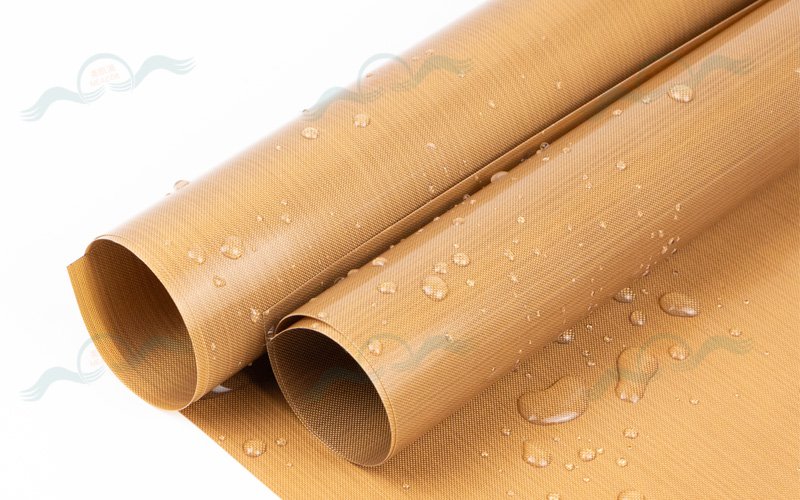
Composite Structure Advantage: The high-strength fiberglass cloth substrate provides outstanding mechanical strength and dimensional stability, while the surface PTFE coating delivers heat resistance, non-stick performance, and a smooth finish. The rigidity of the fiberglass substrate effectively restrains PTFE creep at elevated temperatures, while the PTFE coating protects the substrate from high-temperature oxidation and chemical corrosion.
PTFE Molecular Characteristics: The polytetrafluoroethylene molecular structure is symmetrical and stable, with high carbon-fluorine (C-F) bond energy that resists cleavage at elevated temperatures — resulting in exceptional thermal stability without decomposition or generation of harmful substances.
Precision Manufacturing Process: Produced through multiple sequential processes — coating, impregnation, drying, baking, sintering, and calendering — which achieve a tight, uniform bond between the PTFE and fiberglass substrate, further enhancing the overall structural stability of the composite.
Application Scenarios & Important Notes
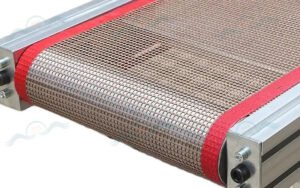
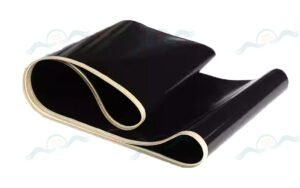
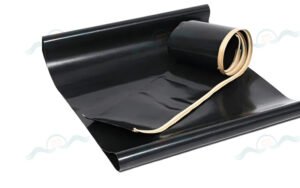
Application Scenarios: Widely used as conveyor belts, release liners, and insulation materials in industrial sectors requiring high-temperature stability — including photovoltaic laminating machines, hot press equipment, food baking, medical sterilization, and aerospace applications.
Important Notes: Although PTFE high-temperature fabric offers excellent high-temperature stability, exceeding its rated temperature range (e.g., continuous operation above 300°C) may still cause performance degradation or deformation. Sharp objects must also be kept away from the coated surface to prevent scratching and premature reduction of service life.
Summary
Through its unique composite structure and the intrinsic material properties of PTFE, PTFE high-temperature fabric delivers outstanding high-temperature stability and deformation resistance across an operating temperature range of -70°C to 260°C (select products up to 300°C). With an elongation coefficient of less than 5‰, it maintains precise dimensional accuracy and stable performance in high-temperature environments over extended service periods — making it an indispensable high-performance material for industrial high-temperature applications.