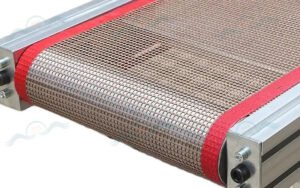
Did you know? PTFE mesh conveyor belts are actually constructed using fiberglass cloth as the base substrate, with a coating of PTFE (polytetrafluoroethylene) resin applied to the surface. This resin is produced by substituting all hydrogen atoms in polyethylene with fluorine atoms, which is precisely what gives it such exceptional chemical stability and non-stick properties.
The mesh design of this conveyor belt is an engineering achievement in its own right — it not only provides excellent breathability but also delivers superior drainage performance. This allows the belt to remain dry and clean during operation, naturally improving overall working efficiency. Just imagine: a constantly wet conveyor belt would not only be prone to corrosion but could also seriously compromise production output.
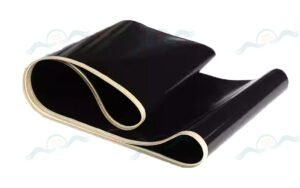
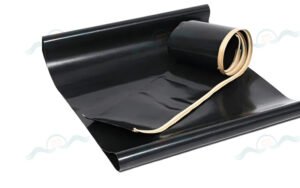
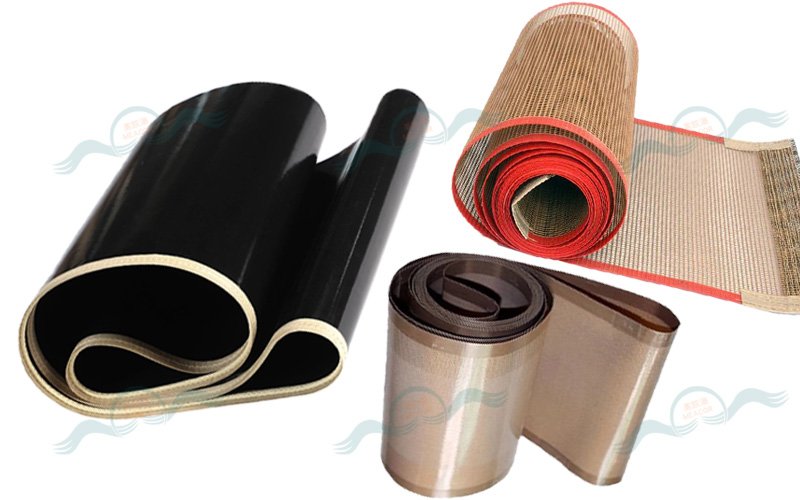
PTFE conveyor belts — also referred to as polytetrafluoroethylene (PTFE) conveyor belts — use fiberglass cloth as their base substrate, coated with a synthetic polymer material in which all hydrogen atoms in polyethylene have been replaced by fluorine atoms. PTFE conveyor belts are classified into two main types: PTFE mesh conveyor belts and PTFE high-temperature fabric belts.
Ⅰ. Product Specifications & Classifications
PTFE Mesh Conveyor Belt:
Specifications are defined by mesh aperture size, with the primary options being 1×1 mm, 2×2.5 mm, 4×4 mm, and 10×10 mm. Furthermore, based on warp and weft yarn configuration, PTFE mesh conveyor belts can be further classified into single-weft and double-weft constructions.
PTFE High-Temperature Fabric Belt:
Specifications are differentiated by thickness, ranging from as thin as 0.08 mm up to 1.0 mm.
Ⅱ. Key Performance Characteristics
Wide Operating Temperature Range: Capable of operating continuously in temperatures ranging from -70°C to 260°C, with excellent weatherability and aging resistance.
Chemical Corrosion Resistance: Resistant to strong acids, strong alkalis, aqua regia, and a wide range of organic solvents.
Flame Retardancy & Breathability: Inherently fire-resistant and flame-retardant, with excellent air permeability.
Non-Stick Surface & Wear Resistance: Virtually nothing adheres to the surface, enabling effortless cleaning; demonstrates outstanding abrasion resistance under high-load conditions.
Dimensional Stability & High Tensile Strength: Excellent dimensional stability with an elongation coefficient of less than 5‰, combined with high mechanical strength.
Based on the above characteristics, PTFE conveyor belts are widely used in textile printing and dyeing, screen printing, UV curing systems, food baking machine guide belts, temperature-controlled drying rooms, and many other applications.
Ⅲ. Industry Applications
The key properties of PTFE conveyor belts — including high-temperature stability, chemical inertness, low coefficient of friction, non-adhesiveness, excellent electrical properties, and wear resistance — make them indispensable across multiple industries:
- Textile Printing & Dyeing Industry:
PTFE mesh conveyor belts, thanks to their open mesh structure and superior breathability, are extensively used in textile printing, dyeing, and print-drying conveyor systems. Their low friction and non-stick surface effectively prevent dye contamination and fabric damage during the dyeing process. - Food Processing Industry:
PTFE high-temperature fabric belts, owing to their high-temperature resistance, low surface friction coefficient, and excellent electrical insulation, are widely deployed on food baking and processing production lines, ensuring full compliance with food safety and hygiene standards. - Chemical Industry & Electronics/Electrical Industry:
PTFE conveyor belts are highly valued in these sectors for their chemical stability and superior electrical insulating properties.
Ⅳ. Belt Joint Methods & Anti-Tracking Features
Available belt joint configurations include: straight lap joint, diagonal lap joint, bull-nose pin joint, and steel clip pin joint.
Anti-tracking guide strips are also available as an add-on option for PTFE conveyor belts to prevent belt misalignment during operation.