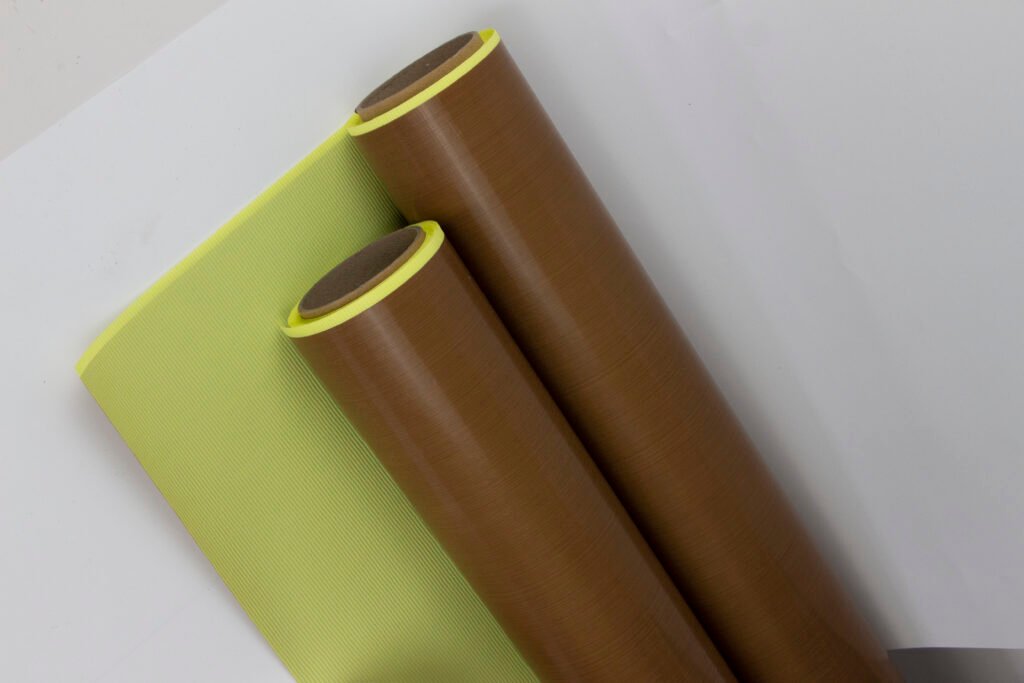
PTFE-coated fiberglass fabric (commonly known as Teflon high-temperature fabric) possesses excellent long-term resistance to acid and alkali corrosion. However, achieving maximum service life depends on meeting specific operating conditions and ensuring proper installation and maintenance. Below are the key conclusions and detailed technical specifications:
I. Core Acid and Alkali Resistance Performance
Chemical Inertness: The Carbon-Fluorine (C-F) bond in the PTFE molecular chain has a bond energy as high as $485\text{ kJ/mol}$, forming a dense “fluorine atom shield” that is almost non-reactive with any chemical substance.
Tolerance Range: It can withstand the full pH range (pH 0–14), PTFE-coated fiberglass fabric including highly corrosive media such as concentrated sulfuric acid, hydrochloric acid, nitric acid, aqua regia, and sodium hydroxide.
Durability Examples: In environments with 30% hydrochloric acid at 180°C, the service life can reach up to 8 years; it also operates stably in power plant desulfurization systems with a pH of 2.
Exceptions: It is only vulnerable to molten alkali metals, elemental fluorine (at high temperatures/pressures), and sodium hydroxide at temperatures exceeding 300°C.
II. Factors Affecting Longevity
| Factor | Key Points | Impact on Longevity |
|---|---|---|
| Temperature Control | Long-term: -196°C to 260°C; Short-term peak: 300°C. | Overheating accelerates PTFE degradation and shortens service life. |
| Mechanical Damage | Avoid sharp scratches, hard bending, or excessive stretching. | Minor punctures become entry points for corrosive penetration. |
| Installation Quality | Tight wrapping, sealed joints, and secure fastening. | Gaps or loosening allow media infiltration, destroying the protective effect. |
| Media Characteristics | Concentration, temperature, flow rate, and abrasive content. | High concentration + high temperature + high flow rate accelerates aging. |
| Product Quality | Coating uniformity, base fabric strength, and adhesion. | Inferior products are prone to coating delamination or peeling. |
III. Key Pipeline Wrapping Application Points
- Pre-treatment: The pipe surface must be sandblasted to remove rust, oil, moisture, and impurities, ensuring a clean and dry substrate.
- Wrapping Method:
Apply even, segmented circumferential wrapping; avoid excessive overlapping or leaving gaps.
Reinforce joints with PTFE-specific sealing tape or gaskets.
Use corrosion-resistant clamps for fastening to prevent direct metal contact with corrosive media. - Maintenance:
Conduct periodic inspections (every 6–12 months) for damage, bulging, or leakage.
Repair or replace damaged sections immediately to prevent corrosion spread.
Minimize pipe vibration and displacement to reduce mechanical stress.
IV. Scenarios and Limitations
Ideal Scenarios:
External corrosion protection for acid/alkali transport pipes in chemical and petrochemical industries.
Harsh environments like power plant desulfurization systems and environmental protection equipment.
High-temperature (≤ 260°C) acid/alkali environments.
Limitations:
Not suitable for molten alkali metals or liquid fluorine.
Performance degrades in strong alkali environments exceeding 300°C.
Limited mechanical strength; requires protection from sharp objects and high-impact forces.
V. Conclusion and Recommendations
Conclusion: Under standardized conditions (Temperature $\le 260^\circ\text{C}$, no mechanical damage, and hermetic sealing), PTFE fabric can provide 8 to 10 years (or longer) of effective corrosion protection, making it a premium choice for external pipeline cladding.
Recommendations:
Select high-quality products with double-sided coating and a thickness of $\ge 0.35\text{mm}$ to ensure coating integrity.
Strictly follow installation protocols, prioritizing joint sealing and secure anchoring.
Establish a routine inspection and maintenance mechanism to address potential issues early.