Technical Innovation Directions for PTFE High-Temperature Fabric (Teflon Coated Fiberglass Cloth)
PTFE high-temperature fabric technology is undergoing a comprehensive breakthrough — evolving from single-performance enhancement toward material compositing, functional integration, precision processing, and application-specific customization. Innovation is centered on five core dimensions: extreme heat resistance, mechanical performance, functional expansion, production efficiency, and environmental sustainability.
Ⅰ. Material Modification & Performance Limit Breakthroughs
1. Nano-Composite Modification Technology
- High-Temperature Stability Enhancement: Addition of nano-alumina and nano-silica fillers raises continuous operating temperature from 260°C to 350–400°C, with short-term peak tolerance exceeding 380°C.
- Thermal-Physical Performance Optimization: Graphene/boron nitride composite modification enables bidirectional thermal conductivity control — as low as 0.18 W/(m·K) for thermal insulation, and as high as 5 W/(m·K) for heat dissipation.
- Mechanical Performance Reinforcement: Nano-carbon fiber reinforcement raises tear strength to 180 N², meeting the stringent requirements of aerospace applications.
- Surface Performance Innovation: Nano-ceramic particle modification reduces the friction coefficient to below 0.04, while simultaneously improving wear life by 3–5 times.
2. Substrate Diversification & Innovation
- High-Performance Fiber Substitution: Aramid fiber, basalt fiber, and carbon fiber replace traditional fiberglass, achieving simultaneous lightweighting (30% weight reduction) and high strength improvement (50% strength increase).
- Composite Substrate Design: Gradient modulus structure (high-wear-resistance PTFE surface layer + functional filler intermediate layer + reinforced fiber base layer), optimized for high-precision applications such as Chiplet packaging.
- Ultra-Thin Substrate Development: 0.05 mm ultra-thin substrates meeting dual requirements of bending radius < 3 mm and puncture resistance > 12 N for solid-state battery lamination processes.
Ⅱ. Composite Structures & Functional Integration Innovation
1. Multi-Layer Composite Functionalization
| Composite Type | Core Innovation | Typical Application |
|---|---|---|
| Thermal Insulation + Load-Bearing | Aerogel/ceramic fiber composite; thermal conductivity < 0.05 W/(m·K) | Spacecraft thermal control skin; nuclear fusion device protection |
| Conductive + Anti-Static | Embedded metal mesh/carbon nanotubes; surface resistance < 10⁶ Ω | Semiconductor packaging; electronic component conveyance |
| Thermally Conductive + Heat Dissipating | Boron nitride/graphene intermediate layer; directional heat conduction | 5G base stations; new energy vehicle battery thermal management |
| Self-Healing Composite | Microcapsule-type repair agent; automatic healing after damage | Chemical corrosion protection; high-temperature sealing |
2. Intelligent Responsive Design
- Temperature Warning Function: Integration of thermochromic materials that automatically change color upon overtemperature, enabling visual safety monitoring.
- Pressure-Sensing Composite: Integrated flexible sensing units for pressure distribution monitoring in high-temperature environments.
- Self-Cleaning Coating: Superhydrophobic nanostructure reduces high-temperature oil fouling adhesion, lowering maintenance costs.
Ⅲ. Manufacturing Process & Equipment Upgrades
1. Coating Process Innovation
- Dynamic Gradient Sintering Technology: AI algorithm-controlled temperature profiling improves coating uniformity by 40%, achieving a yield rate of 95.7%.
- Plasma-Enhanced Deposition (PED): Atomic-level precision control of coating structure raises adhesion strength to 2.6 MPa, resolving the traditional contradiction between high heat resistance and high non-stick performance.
- Solvent-Free Coating Technology: Water-based PTFE emulsion replaces solvent-based systems, reducing VOC emissions by 90% and achieving full compliance with EU REACH regulations.
2. Forming & Processing Breakthroughs
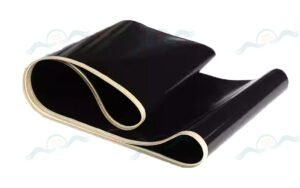
- Seamless Annular Integrated Molding: Eliminates traditional splice joint weaknesses, extending service life by 2 times — suitable for high-speed transmission applications.
- Ultra-Wide Width (≥3.2 m) Warping Tension Closed-Loop Control: Domestically produced equipment replaces imports, with width precision controlled to within ±0.5 mm.
- Laser Micro-Machining: Precision fabrication of micron-level micropores and surface textures for specialized breathability and filtration requirements.
3. Intelligent Quality Control
- Online Plasma Diagnostic System: Real-time coating quality monitoring with automatic process parameter adjustment.
- Machine Vision Defect Detection: Identifies micro-defects as small as 0.1 mm; defect rate reduced to below 0.3%.
Ⅳ. Application-Specific Customization Innovation
1. New Energy Sector Specialization
- Solid-State Battery Dedicated Type: Ultra-thin, highly flexible, electrolyte-resistant — optimized for roll-to-roll lamination processes.
- Hydrogen Fuel Cell Bipolar Plate Coating: Combines electrical conductivity, corrosion resistance, and low contact resistance — improving fuel cell efficiency by 15%.
- Photovoltaic Silicon Wafer Cutting Belt: High wear resistance and low dust generation — improving cutting precision to ±2 μm.
2. Electronics & Semiconductor High-End Applications
- Chiplet Packaging Thermal Compression Film: Gradient modulus + high thermal conductivity — optimized for micron-level precision thermocompression bonding.
- High-Frequency High-Speed PCB Substrate: Ultra-low dielectric constant (Dk = 2.0–2.2) — supporting 100 GHz+ signal transmission.
- Flexible Circuit Encapsulation Fabric: Ultra-thin (0.03 mm) + flex fatigue resistance (10⁶ bending cycles) — for wearable device applications.
3. Aerospace & Extreme Environment Applications
- Thermal Control Skin Material: Lightweight + ultra-high temperature resistance — for hypersonic aircraft applications.
- Engine Compartment Thermal Insulation Fabric: Integrated fire resistance, noise reduction, and thermal insulation — achieving 25% weight reduction.
- Deep Space Exploration Equipment Protection: Withstands alternating temperatures from -200°C to 350°C; resistant to cosmic radiation.
Ⅴ. Green & Low-Carbon Sustainable Development
1. Eco-Friendly Material Systems
- Water-Based PTFE Emulsion Industrialization: Achieved by enterprises including Juhua Group, completely eliminating VOC emissions.
- Bio-Based PTFE Precursors: Synthesized from renewable resources, reducing carbon footprint by 40%.
- Recyclable PTFE Technology: High-temperature depolymerization and purification for reuse — achieving a material recycling rate of 85%.
2. Energy-Saving Process Development
- Microwave-Assisted Sintering: Energy consumption reduced by 30%; production cycle shortened by 50%.
- Waste Heat Recovery Systems: Thermal energy utilization rate on coating production lines improved to 75%.
Ⅵ. Future Technology Development Trends
- Atomic-Level Precision Manufacturing: With large-area uniform plasma source technology and AI process optimization algorithms, PED technology will achieve atomic-level coating structure control.
- Multi-Function Integration: Single materials integrating high-temperature resistance, thermal conductivity/insulation, electrical conductivity/insulation, sensing, and self-healing capabilities.
- Extreme Environment Adaptation: Expanding into increasingly demanding scenarios including ultra-high temperature (500°C+), ultra-low temperature (-269°C), strong corrosion, and intense radiation environments.
- Domestic Substitution Acceleration: Import dependency for high-end electronic-grade and aerospace-grade products is projected to decline from 35% in 2025 to below 10% by 2030.
In summary, technical innovation in PTFE high-temperature fabric has entered a stage of full-chain collaborative development spanning materials, structures, processes, and applications. The core driving forces are the differentiated demands of high-end sectors including new energy, semiconductors, and aerospace — coupled with global green and low-carbon policy directives.