How to Determine Whether the Adhesion of PTFE Anti-Stick Fabric Tape Is Normal?
Assessing the adhesion of PTFE anti-stick fabric tape requires a combination of professional instrument testing and simple manual inspection, focusing on three core indicators: initial tack (initial bonding capability), peel strength (sustained adhesion force), and holding power (long-term load retention capability).
Ⅰ. Professional Instrument Testing Methods (Precise Determination)
1. Initial Tack Test (GB/T 4852 Rolling Ball Method)
| Step | Key Operation | Acceptance Criteria |
|---|---|---|
| Preparation | Secure tape flat on a 30° inclined test board with adhesive side facing up | — |
| Testing | Starting from the largest steel ball (e.g., No. 32, diameter 25.4 mm), progressively reduce ball size; observe whether the ball stops completely on the tape after rolling down freely | The higher the ball number that stops, the stronger the initial tack; industrial-grade PTFE tape should stop a ball of No. 15 or above |
| Environment | Standard laboratory conditions: 23 ± 2°C, 50 ± 10% RH | — |
2. Peel Strength Test (GB/T 2790-1995)
| Step | Key Operation | Acceptance Criteria |
|---|---|---|
| Preparation | Bond tape to stainless steel panel; roll with 2 kg standard roller, 3 passes in each direction | — |
| Testing | Peel at 180° angle at 300 mm/min; record average peel force | Peel strength on steel ≥ 6.0 N/25 cm (premium products: 8–12 N/25 cm) |
| Evaluation | Force-displacement curve should be smooth with no significant peaks/valleys and no adhesive failure | — |
3. Holding Power Test (GB/T 4851)
| Step | Key Operation | Acceptance Criteria |
|---|---|---|
| Preparation | Bond tape to test panel; suspend 1 kg weight | — |
| Testing | Record tape slip distance or time to detachment | Slip distance ≤ 0.125 inches (3 mm)/hour, or no detachment for ≥ 72 hours |
| High-Temperature Test | Conduct at 200°C to evaluate high-temperature tack retention rate | Premium products retain 80% of initial tack at 250°C |
Ⅱ. Simple Manual Inspection Methods (Rapid On-Site Assessment)
1. Basic Tack Testing
- Hand feel test: Press tape lightly onto a clean stainless steel surface and peel off quickly — there should be clearly perceptible adhesion with no easy detachment
- Repeated bonding test: Apply and remove at the same location 20 times — the adhesive surface of a qualified tape should remain clean and intact with no delamination, adhesive transfer, or bubbles
- Edge inspection: Tape edges should be flat with no natural lifting or adhesive squeeze-out
2. Adhesive Residue Test (Key Indicator)
- Peel the tape at a uniform speed of 3–5 seconds/meter — the bonded surface must show no adhesive residue
- Scrape the adhesive surface with a fingernail — no adhesive layer detachment or powder-like material should be produced
3. High-Temperature Performance Test (Core PTFE Advantage)
- Heat to 200°C (PTFE standard operating temperature); hold for 1 hour; allow to cool
- Inspect whether tack has noticeably decreased or whether the adhesive layer has flowed, cured, or become brittle
Ⅲ. Typical Manifestations of Adhesion Abnormalities & Assessment Criteria
| Abnormal Phenomenon | Possible Cause | Assessment Conclusion |
|---|---|---|
| Poor initial tack; detaches at slightest touch | Adhesive layer too thin; incomplete curing; formulation issue | Non-conforming; cannot meet basic fixation requirements |
| Adhesive layer detaches completely during peeling | Insufficient adhesion between adhesive layer and substrate; poor cohesive strength of adhesive | Serious quality defect; must not be used |
| Severe adhesive residue after high-temperature exposure | Insufficient high-temperature resistance of adhesive layer; curing process defect | Non-conforming; affects performance and equipment cleanliness |
| Inconsistent tack at ambient temperature | Poor storage conditions (humidity, direct sunlight); unstable batch quality | Not recommended for use; safety risk present |
| Edge delamination and lifting | Uneven coating application; improper rewinding tension control | Edge tack failure; compromises overall performance |
Ⅳ. Important Notes for PTFE Tape Adhesion Assessment
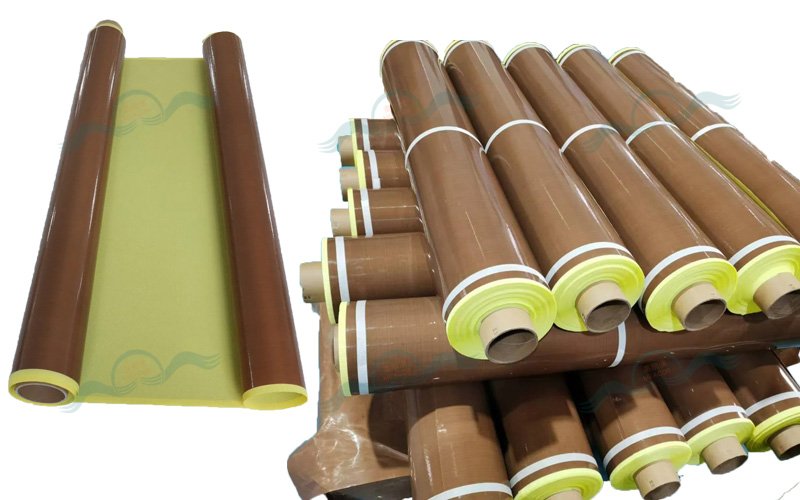
Distinguish Substrate Face from Adhesive Face: PTFE tape has one side coated with PTFE (anti-stick — adheres to virtually nothing) and one side with the pressure-sensitive adhesive layer. Always confirm that the adhesive face is being tested.
Environmental Factor Influences:
- Temperature: PTFE tape tack follows a “bell curve” pattern — optimal tack at medium temperatures (20–50°C); tack decreases at high temperatures (> 250°C) or low temperatures (< -20°C)
- Humidity: High humidity may affect the adhesive surface condition — ensure the adhesive face is dry and clean before testing
Comparative Testing Approach:
- Compare against a certified reference sample of the same batch and grade — significant differences indicate potential quality issues
- Record all test data; establish a batch quality archive for traceability purposes
Ⅴ. Summary
Assessing whether the adhesion of PTFE anti-stick fabric tape is normal can be accomplished through professional instrument testing of three core indicators (initial tack, peel strength, and holding power), as well as through manual testing for rapid performance evaluation. The key criteria are: stable adhesion, no adhesive failure, no residue, and maintained tack performance at elevated temperatures. If any abnormality is detected, discontinue use immediately and contact the supplier to prevent production incidents or product quality issues caused by adhesion failure.