What Factors Are Related to the Temperature Resistance Performance of PTFE Teflon Tape?
The temperature resistance performance of PTFE tape is influenced by six core factors: substrate characteristics, adhesive type, thickness and density, additives/fillers, structural design, and operating conditions. Among these, substrate and adhesive type are the critical determinants of the upper temperature limit, while the remaining factors affect stability and service life in practical applications.
Ⅰ. Substrate Characteristics — The Core Determinant of the Temperature Resistance Upper Limit
PTFE Purity & Molecular Structure
- Virgin PTFE has a carbon-fluorine (C-F) bond energy of 485 kJ/mol; melting point approximately 327°C; long-term operating range -200°C to 260°C; short-term tolerance up to 300°C
- Impurities reduce thermal stability and accelerate high-temperature degradation — the higher the purity, the better the temperature resistance
- Molecular chain cross-link modification improves thermal stability; certain cross-linked PTFE grades can be used continuously from -196°C to 300°C, with only 0.6% weight loss after 120 hours at 350°C
Substrate Type & Reinforcement Method
| Substrate Type | Thermal Characteristics | Applicable Scenarios |
|---|---|---|
| Pure PTFE Film | Base heat resistance 260°C; excellent flexibility | Light-load, high-precision bonding applications |
| Fiberglass-Reinforced PTFE | Fiberglass melting point ~1,000°C; improved structural stability in composite; withstands higher thermal stress | High-temperature heavy-duty applications such as welding protection and heat sealing machinery |
| Other Reinforced Substrates (e.g., Kevlar) | Provides higher mechanical strength; temperature range similar to fiberglass-reinforced | Special high-temperature high-strength requirements |
Ⅱ. Adhesive Type — The Thermal Bottleneck of the Bonding Layer
The adhesive layer is commonly the weakest link in PTFE tape temperature resistance; different adhesive types exhibit significant performance differences:
| Adhesive Type | Temperature Range | High-Temperature Performance | Applicable Scenarios |
|---|---|---|---|
| Silicone Pressure-Sensitive Adhesive | -70°C to 280°C; continuous 260°C | Retains 80% of initial tack at 250°C; no softening or adhesive failure | Most industrial high-temperature applications |
| Acrylic Pressure-Sensitive Adhesive | -40°C to 150°C | Prone to softening and flow above 100°C | Low to medium-temperature applications |
| Adhesive-Free (Mechanical Fixation) | Consistent with PTFE substrate (260°C) | No adhesive failure risk | Thread sealing, pipeline wrapping, and other applications not requiring adhesive fixation |
Ⅲ. Thickness & Density — Key Parameters for Thermal Resistance & Heat Distribution
Thickness Affects Thermal Resistance: Thermal resistance formula R = δ/k (where δ = thickness; k = thermal conductivity); PTFE thermal conductivity k ≈ 0.25 W/(m·K). Increasing thickness from 0.13 mm to 0.30 mm raises thermal resistance by 130%, significantly enhancing thermal insulation effectiveness.
Density & Compactness: Higher-density PTFE has more tightly packed molecular arrangement, more uniform heat conduction, and greater structural stability at elevated temperatures — superior temperature and pressure resistance compared to lower-density products.
Thickness-Stability Balance: Excessive thickness may reduce flexibility and compromise conformability. Optimal ranges are typically 0.13–0.40 mm (fiberglass type) and 0.08–0.50 mm (pure film type).
Ⅳ. Additives & Fillers — A Double-Edged Sword for Performance
Additives can improve specific properties but may affect temperature resistance:
- Reinforcing fillers: Fiberglass and carbon fiber improve mechanical strength and thermal stability; certain filled PTFE grades can withstand short-term temperatures up to 316°C
- Lubricating fillers: Graphite and molybdenum disulfide reduce friction coefficient but may slightly lower the upper temperature limit
- Conductive fillers: Metal powders provide electrical conductivity but are prone to oxidation at high temperatures, compromising long-term stability
- Purity requirements: Food and medical applications require unfilled pure PTFE to ensure safety and consistent temperature resistance
Ⅴ. Structural Design — Synergistic Effect of Composite Layers
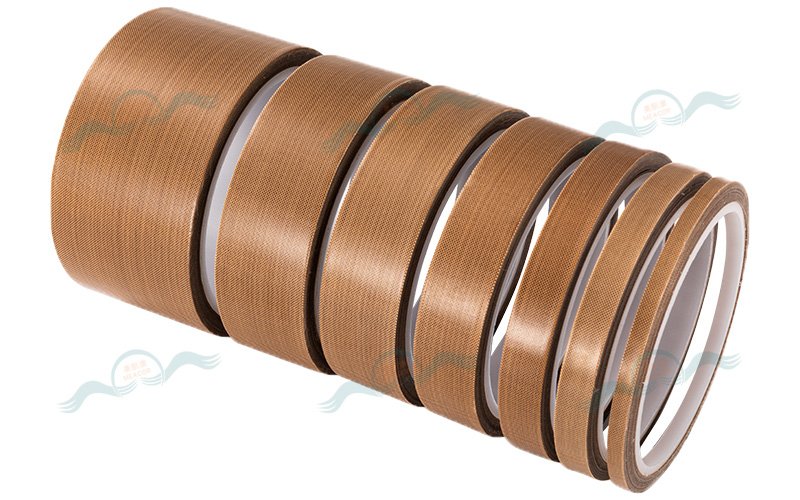
Composite Structure Optimization: Premium PTFE tape adopts a three-layer structure: “fiberglass cloth + PTFE coating + silicone pressure-sensitive adhesive” — fiberglass provides structural strength, PTFE delivers heat resistance and non-stick performance, and silicone ensures stable high-temperature adhesion.
Coating Process Impact: Sintering temperature and duration determine PTFE crystallinity. High-temperature sintering at 380°C enables full PTFE molecular chain crystallization and cross-linking, significantly improving thermal stability.
Surface Treatment Technology: Etching, plasma treatment, and similar processes improve adhesion between PTFE and the adhesive layer, reducing high-temperature delamination risk and indirectly ensuring temperature resistance performance.
Ⅵ. Operating Conditions — The Dynamic Variable in Actual Temperature Resistance
- Duration of Temperature Exposure: Short-term peak temperature (e.g., 300°C for a few minutes) has less impact than prolonged high-temperature exposure (e.g., 260°C for hundreds of hours) — thermal-oxidative aging accumulates over time
- Mechanical Load & Pressure: High-pressure environments accelerate creep and deformation, reducing effective temperature resistance; upper temperature limit is higher under no-load conditions
- Chemical Environment: Most chemical media have no effect on PTFE, but certain strong oxidizing agents (e.g., fluorine gas) may trigger degradation at high temperatures; acid/alkali environments can affect adhesive layer performance
- Thermal Cycling Frequency: Frequent heating-cooling cycling causes material fatigue, reduces thermal service life, and compromises structural stability
Summary & Application Recommendations
Core Principle: PTFE tape temperature resistance performance is the combined result of intrinsic material properties and application conditions. Both substrate and adhesive temperature limits must be considered simultaneously when selecting products for specific operating conditions.
Selection Guidelines:
- High-temperature heavy-load applications → Fiberglass-reinforced + silicone adhesive grade
- Light-load high-precision applications → Pure PTFE film grade
- Special chemical environments → Confirm compatibility with unfilled pure PTFE
Operating Limits: Avoid continuous operation above 260°C; keep short-term peak temperature within 300°C; minimize mechanical stress and chemical attack to maximize service life.