How Does the Dielectric Voltage Withstand Performance of PTFE High-Temperature Fabric Change at Different Temperatures?
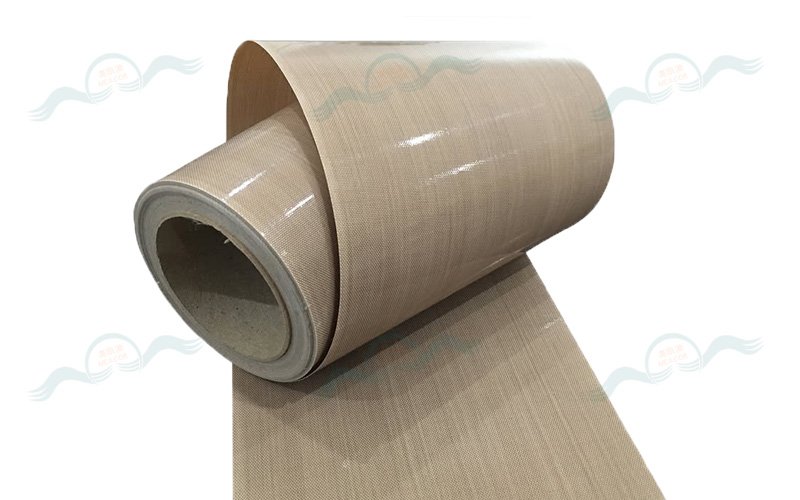
The dielectric voltage withstand performance (primarily dielectric strength / breakdown voltage) of PTFE high-temperature fabric (PTFE-coated fiberglass cloth) follows a “stable first, then declining” pattern with temperature changes. It remains relatively stable throughout the continuous operating temperature range of -70°C to 260°C, with significant decline only occurring when approaching or exceeding the PTFE melting point (327°C).
Ⅰ. Basic Electrical Insulation Characteristics
PTFE high-temperature fabric inherits the outstanding electrical properties of PTFE:
- Dielectric Constant: Approximately 2.6 (pure PTFE: 2.0–2.1)
- Dielectric Dissipation Factor: < 0.0025; stable performance at high frequencies
- Breakdown Voltage: Effective value typically > 1 kV (specific value depends on thickness and process)
- Volume Resistivity: 10¹⁸ Ω·cm level; surface resistivity 10¹⁶ Ω level
Ⅱ. Dielectric Voltage Withstand Performance Changes by Temperature Range
1. Low-Temperature Range (-196°C to -70°C)
- Performance: Dielectric voltage withstand performance shows virtually no change; dielectric strength maintained at levels equivalent to ambient temperature
- Reason: Although PTFE molecular chain mobility is restricted at low temperatures, the C-F bond stability remains extremely high — no embrittlement or structural damage occurs; excellent insulation performance is fully maintained
- Application: Suitable for use as insulation material in deep cryogenic environments
2. Ambient Temperature to Continuous Operating Temperature Upper Limit (25°C to 260°C)
- Performance: Dielectric voltage withstand performance remains highly stable; dielectric strength degradation is minimal (typically < 10%)
- Key Reference Points:
- 25°C (ambient): Baseline performance; highest dielectric strength
- 100°C–200°C: Performance essentially unchanged; only minor increase in molecular thermal motion
- 260°C (continuous operating upper limit): Remains stable with no significant performance degradation
- Advantage: Compared to standard insulating materials (e.g., PVC which degrades sharply above 80°C), PTFE high-temperature fabric demonstrates outstanding insulation stability at elevated temperatures
3. Short-Term Tolerance Temperature Range (260°C to 300°C)
- Performance: Begins to decline slowly; however, a relatively high dielectric voltage withstand level is still maintained
- Time Dependency: Short-term exposure (hours to tens of hours) has minimal impact; long-term exposure (hundreds of hours) may cause minor performance degradation
- Note: This temperature range is suitable for short-term use only; continuous operation is not recommended
4. Near-Melting Point to Decomposition Temperature (300°C to 327°C)
- Performance: Significant decline; dielectric strength may decrease by 30–50%
- Reason: PTFE begins to soften; crystallinity decreases; molecular chain thermal motion intensifies; internal defects (such as micropores) more readily develop into breakdown pathways under electric field stress
- Critical State: As temperature approaches 327°C, material transitions from solid to molten state; insulation performance deteriorates substantially
5. Above Decomposition Temperature (> 327°C)
- Performance: Dielectric voltage withstand performance is completely lost; thermal decomposition occurs; toxic gases are generated
- Safety Limit: No significant thermal decomposition below 340°C for short periods (< 300 hours); at 400°C, PTFE completely loses thermal stability and electrical performance
Ⅲ. Key Factors Affecting Dielectric Voltage Withstand Performance Change
| Factor | Influence Mechanism | Role in Temperature Dependence |
|---|---|---|
| Substrate & Coating | Fiberglass substrate has stable insulation properties; PTFE coating determines overall electrical characteristics | Reduces the impact of temperature on overall performance; enhances structural stability |
| Thickness | Thicker material has higher absolute breakdown voltage; but dielectric strength per unit thickness is lower | Increased thickness moderates performance degradation at elevated temperatures |
| Process Quality | Coating uniformity, porosity, and impurity content affect internal electric field distribution | Premium process quality improves high-temperature performance stability; reduces localized breakdown risk |
| Environmental Conditions | Humidity, oxygen concentration, and electric field frequency interact synergistically with temperature | Combined high-temperature/high-humidity environment accelerates performance degradation; dielectric strength is slightly lower at high frequencies |
Ⅳ. Comparison with Pure PTFE Material
Similarities: The overall trend of dielectric voltage withstand performance change with temperature is consistent — both remain stable below 260°C.
Differences:
- PTFE high-temperature fabric, reinforced with fiberglass, has higher mechanical strength and better dimensional stability at elevated temperatures — indirectly improving insulation reliability
- Pure PTFE film dielectric strength can reach 50–80 kV; high-temperature fabric is typically slightly lower (30–50 kV) due to substrate influence
- High-temperature fabric dielectric voltage withstand performance is slightly less sensitive to temperature than pure PTFE, as the fiberglass restricts PTFE molecular chain thermal motion
Ⅴ. Application Recommendations
- Within the -70°C to 260°C operating range, there is no need to be concerned about significant dielectric voltage withstand degradation — insulation structures can be designed based on ambient temperature parameters
- Short-term operating temperature should not exceed 300°C; if it does, reduce design voltage or increase insulation thickness accordingly
- In high-temperature environments (> 200°C), avoid prolonged continuous use; periodically inspect insulation performance
- Select products with excellent manufacturing process quality and uniform coating to achieve more stable dielectric voltage withstand performance and broader temperature adaptability
The outstanding stability of PTFE high-temperature fabric’s dielectric voltage withstand performance throughout its continuous operating temperature range is a critical differentiator from other insulating materials — making it the ideal choice for insulation applications in demanding environments involving high temperatures, high frequencies, and high voltages.