Manufacturing Processes, Properties, and Applications of PTFE Adhesive Tapes
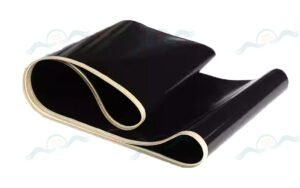
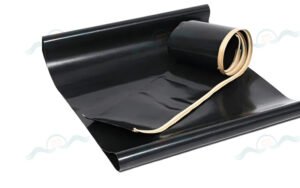
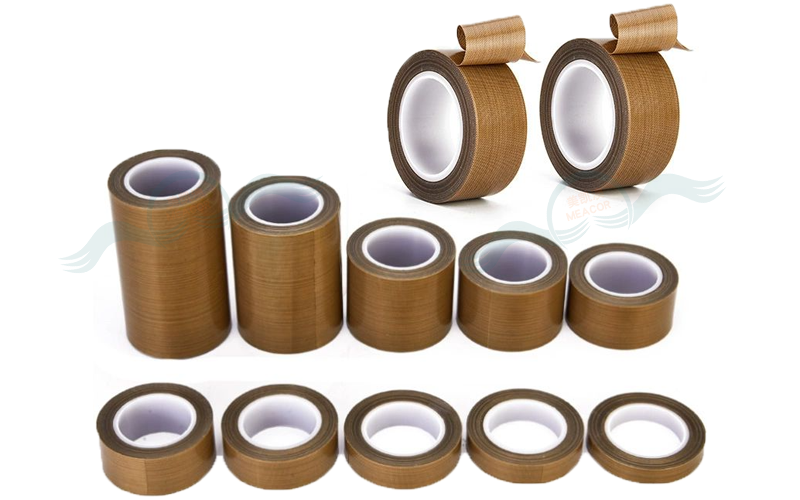
PTFE (Teflon) adhesive tapes in industrial sectors are divided into two primary categories with distinct manufacturing routing lines: Fiberglass-reinforced PTFE high-temperature tapes (the market mainstream for non-stick, heat-sealing, and insulation needs) and Pure PTFE skived film/thread seal tapes (for pipeline sealing and dielectric fields).
I. Manufacturing Process of Fiberglass-Reinforced PTFE Tapes (Mainstream Industrial Profile)
This variant utilizes an alkali-free fiberglass fabric as the structural skeleton, with both or single sides coated with PTFE resin dispersion, and the reverse side compounded with a high-temperature silicone pressure-sensitive adhesive (PSA).
- Raw Material Preparation:
- Substrate: Alkali-free fiberglass plain or twill fabric (30–200 g/m²) dictating tensile strength and dimensional boundaries.
- Coating Slurry: Dispersed PTFE emulsion holding a solid content of 60%±2%, combined with surfactants and leveling agents. High-performance lines fill this matrix with MoS₂ or Boron Nitride to step up wear resistance.
- Adhesive Mass: Modified silicone pressure-sensitive adhesive rated for continuous heats above 260°C.
- Coupling Agent: Titanate or silane coupling agents utilized to elevate interfacial chemical bonding between the glass cloth and the PTFE topcoat.
- Substrate Surface Pre-treatment:
The fiberglass cloth is dip-coated into a silane coupling agent solution (3%–6% mass concentration) for 1–2 hours. Squeeze rollers limit the wet pickup rate to 30%–40%, followed by convection drying at 70°C–90°C for 3–5 hours to establish an interfacial anchoring layer that prevents subsequent coating delamination. - PTFE Dispersion Coating and Flash-Drying:
Utilizing reverse roll coating or slot-die extrusion coating, wet film thicknesses (25–60 μm) are applied. Coating gaps are monitored via laser gauges to achieve a precision variance of ±0.5 μm. The wet film goes through a flow-out stage under a cleanroom profile (23±1°C, 45%±3% RH) to eliminate surface pinholes, then treks through a three-zone gradient vertical drying tower:
- Zone 1 (80°C–100°C): Flash-off of unbound moisture.
- Zone 2 (120°C–150°C): Removal of volatile surfactant matrices.
- Zone 3 (180°C–200°C): Initial film compaction.
This “coating-drying” sequence is cycled 2 to 4 times to accumulate the target weight.
- High-Temperature Sintering and Fusion (The Core Critical Stage):
The dried composite runs through a three-stage high-heat sintering kiln to merge the discrete PTFE particles into a continuous phase:
- Pre-heating Zone (250°C–300°C): Steady thermal ramping to prevent pocket blistering.
- Gel/Fusion Zone (360°C–380°C): Operating well above the crystalline melting point of PTFE (327°C) to drive complete chain entanglement and fuse a dense, continuous fluoropolymer skin.
- Cooling Zone: Regulated cooling below 80°C to minimize residual internal mechanical stresses.
- Adhesive Backing Coating and Cross-linking:
The non-working side of the sintered PTFE glass cloth undergoes single-sided surface modification (chemical sodium-naphthalene etching or plasma treatment) followed by the application of silicone PSA (15–30 μm gauge). It routes into a curing oven tracking at 120°C–180°C to lock in cross-linking networks, securing a peel strength profile of 0.8–1.5 N/mm (ASTM D3330) with zero adhesive transfer under 260°C conditions. - Slitting, Rewinding, and Quality Inspection:
The wide master jumbo rolls are converted on precision slitters into narrow custom widths (10 mm, 50 mm, etc.), inspected for thickness consistency, dielectric breakdown voltage, and peel tracking, and interwound with release liners for shipping.
II. Manufacturing Process of Pure PTFE Thread Seal Tapes (Unreinforced)
- Material Paste Compounding: Fine-powder PTFE dispersion resin is blended with a hydrocarbon extrusion aid (lubricant oil/petroleum ether).
- Cold Preforming: The paste is hydraulically compressed inside cylindrical dies to yield a uniform density preform.
- Ram Extrusion: A vertical ram extruder forces the preform through an annular die configuration, generating a heavy-walled cord profile.
- Calendering & Longitudinally Stretching: Multiple high-pressure calender rolls continuously step down the gauge, followed by single-axis thermal stretching to align the crystalline molecular structures, augmenting longitudinal tensile strength while preserving a porous un-sintered profile for mechanical sealing.
- Devolatilization & Slitting: Low-heat exposure drives off volatile lubricants before final slitting.
III. Property Profiles and Application Fields
Core Engineering Features:
- Direct Surface Retrofitting: Avoids complex on-site thermal spray processes for drying cylinders, delivering immediate non-stick release.
- Heavy-Duty Protection: Long-term thermal capacity up to 260°C with an ultra-low friction coefficient, high wear protection, and persistent silicone backing anchorage.
- Seamless On-Site Application: Restores processing equipment surfaces directly without teardowns, minimizing operational downtime.
- Standard Gauges: Fiberglass-backed models range from 0.13 to 0.40 mm total thickness; pure skived PTFE tape variations range from 0.08 to 0.40 mm.
Typical Target Deployments:
- Serves as high-performance chemical gaskets, low-friction slider plates, wide-frequency dielectric insulation layers, and capacitor wrap barriers.
- Universally utilized in packaging, plastic extrusion thermoforming, continuous lamination, packaging heat-sealing bars, and electrical arrays where repeatable repositioning and reliable release are required.