Application Instructions for PTFE (Teflon) Adhesive Tapes on Sizing Cylinders
I. Step-by-Step Installation Manual for Drying Cylinders
a. Surface Preparation: Thoroughly clean the surface of the drying cylinder where the tape will be applied. Ensure the surface is entirely free of iron filings, debris, or oil residues, and presents a completely smooth profile.
b. Material Sizing: Measure and cut a section of PTFE tape slightly longer than the required dimension (allow an excess margin of approximately 5 cm) for standby application.
c. Progressive Placement: Peel back the release liner progressively—apply the tape while peeling simultaneously rather than removing the entire liner at once. During this process, utilize a clean cloth (or folded newspaper) to rub and firmly press the tape flat against the surface. Ensure both edges of the wrapped tape overlap seamlessly at the finish line.
d. Precision Seaming (Flush-Joint Cutting): Along the longitudinal centerline of the overlapping section (parallel to the cylinder length), use a utility knife to score a precise straight line. Peel off and discard the excess scrap material from Layer A, then lift the flap.
e. Bubble Elimination and Final Seating: Carefully inspect the entire applied surface for trapped micro-air bubbles. If bubbles are detected, pierce them individually using a pin or sharp fine point, then smooth the surface out flat. Peel away the waste section from Layer C underneath, flip back the matching Layer B, and smooth out both Layer B and Layer D seamlessly to achieve a flawless flush-joint seam.
II. Product Definitions, Classifications, and Property Profiles
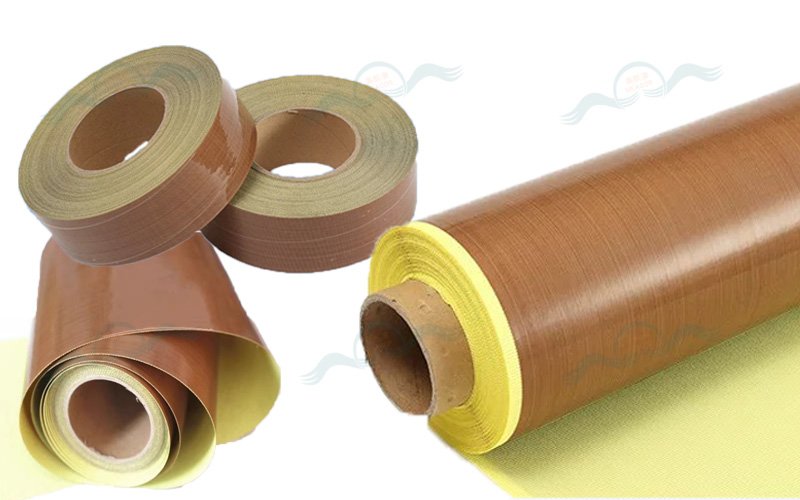
PTFE adhesive tape—alternatively known in industrial trading as Teflon adhesive tape, Teflon film tape, Teflon fiberglass tape, PTFE high-temperature tape, or skived four-fluoride tape—is engineered by impregnating imported fiberglass yarn matrixes with high-purity polytetrafluoroethylene resin, followed by specialized structural treatments and single-sided coating with premium high-temperature silicone pressure-sensitive adhesive. It is categorized into two primary structural forms based on the core carrier material:
- PTFE Fiberglass-Reinforced Tape (Woven substrate matrix)
- PTFE Skived Film Tape (Pure unsupported fluoropolymer film)
Key Technical Features:
- Elite Temperature Range: Maintains robust adhesion and structural integrity under continuous operating temperatures exceeding 260°C, ensuring safe deployment on high-output electric heating components.
- Anti-Adhesion Release: Features an ultra-low surface energy face; molten plastic packaging film residues or “slag” cannot adhere to the heat-sealing tool surface.
- Outstanding Dielectric Strength: Delivers high electrical insulation barriers across variable frequencies.
- High Dimensional Stability: Resists tracking deformation, exhibits high mechanical durability, and minimizes maintenance cycles.
III. Mainstream Industrial Application Scenarios
- High-heat sealing and pressure-bonding sections for food, dairy, and pharmaceutical packaging.
- Heat-sealing and shrink-wrapping zones for continuous plastic film processing.
- Surface protection lining for precision sizing cylinders, textile print-dyeing drums, and resin processing rollers.
- Roller face wrapping for adhesive laminators, hot-melt coaters, and transfer compounding machinery.
- Low-friction liners for bulk material feeding hoppers, chutes, and mechanical slide guides.
- Protective non-stick cladding for component surfaces demanding absolute slickness and zero chemical adhesion.
- Dielectric insulation liners, structural spacers, slot wraps, and electrical barrier insulation covers.