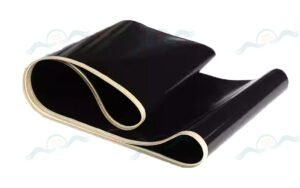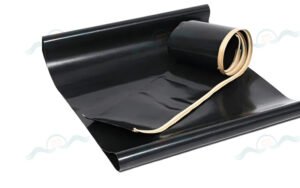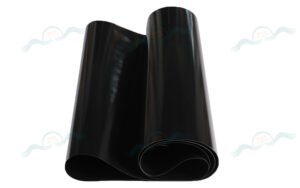
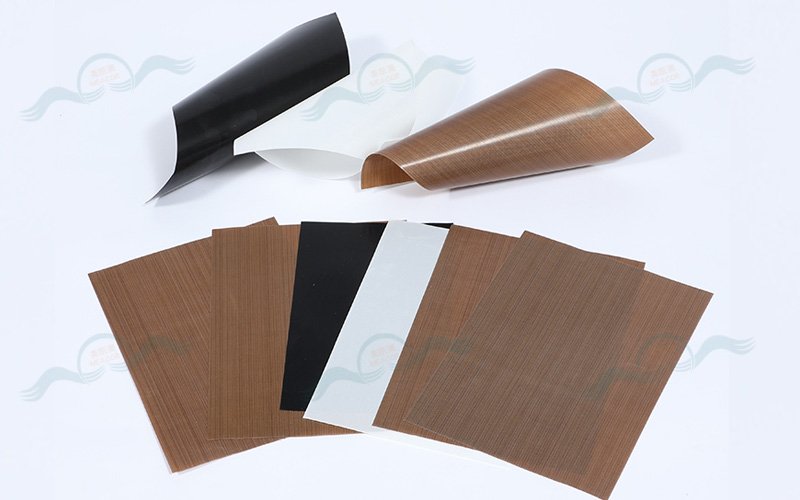
Next-Generation PTFE High-Temperature Fabric — Performance Upgraded for Stable Continuous Operation at 260°C
The new generation of PTFE high-temperature fabric achieves a revolutionary improvement in stability under 260°C operating conditions through three core technical pathways: substrate reinforcement, coating modification, and process optimization — resolving the critical pain points of delamination, deformation, and strength degradation associated with traditional products under prolonged high-temperature use.
Ⅰ. Performance Comparison: Traditional vs. Upgraded Product
| Performance Dimension | Traditional Product | Upgraded Product | Improvement |
|---|---|---|---|
| Continuous use duration at 260°C | Approx. 30–50 days | 200+ days with zero strength degradation | 4× improvement |
| Dimensional stability | Elongation rate 1–3% | Elongation rate < 5‰ | 60%+ improvement |
| Thermal aging weight loss | 350°C/120h: > 2% | 350°C/120h: only 0.6% | 70%+ improvement |
| Upper temperature limit | Continuous 260°C / Short-term 280°C | Continuous 260°C / Short-term 300°C | 7%+ improvement |
Ⅱ. Three Core Technical Breakthroughs — The Foundation of Stability Enhancement
1. Substrate Composite Reinforcement Technology
- High-Strength Fiberglass Upgrade: High-modulus E-CR fiberglass; warp direction tensile strength reaches 3,450 N/5cm; creep resistance improved by 40%
- Composite Substrate Innovation: Introduction of aramid fiber hybrid weaving or metal mesh interlayer, maintaining structural rigidity at 260°C; tear resistance improved by 2–3 times
- Interface Bonding Optimization: Plasma surface treatment of substrate increases PTFE coating adhesion by 50%, completely eliminating high-temperature delamination
2. PTFE Coating Modification Technology
- Molecular Chain Directional Alignment: Magnetic field-assisted forming aligns PTFE molecular chains along the load-bearing direction; thermal stability improved by 30%
- Nano-Filler Reinforcement: Addition of nano-silica or graphene increases coating density; thermal conductivity reduced by 15%, enhancing thermal insulation performance
- Cross-Link Structure Optimization: Special curing agents form a three-dimensional network structure; fluorocarbon bond breakage rate at 260°C reduced by 60%
3. Precision Manufacturing Process Innovation
- Gradient Temperature Sintering: Three-stage temperature ramping (120°C → 200°C → 380°C) ensures uniform and dense PTFE micropore structure, preventing localized thermal damage
- Multi-Pass Impregnation Coating: 5–7 repeated impregnation passes; coating thickness tolerance controlled to ±0.01 mm; surface roughness Ra < 0.2 μm
- Constant-Temperature Homogenization Treatment: 48-hour pre-aging at 260°C releases internal stress in advance; dimensional change in field use < 0.1%
Ⅲ. Verified Performance at 260°C — Measured Test Data
Long-Term Thermal Stability Testing
- Continuous use at 250°C for 200 days: tensile strength retention rate 98%; elongation at break change < 0.5%
- 260°C cyclic testing (16 hours high-temperature / 8 hours ambient per day): no visible aging after 100 cycles
- Following short-term exposure to 300°C (30 minutes) and return to 260°C operating conditions: zero performance degradation
Extreme Condition Adaptability
- Thermal shock testing (-70°C → 260°C, 10 cycles): no cracking, no delamination, no dimensional anomalies
- Combined chemical corrosion + high-temperature testing (260°C + 5% H₂SO₄ vapor): continuous 72 hours with zero weight loss and zero discoloration
- Dynamic friction testing (260°C, 120 cycles/minute): friction coefficient maintains 0.05–0.08 after 300 hours with no significant wear
Ⅳ. Upgraded Application Scenarios — From Passive Protection to Active Thermal Management
| Industry | Traditional Pain Points | Upgraded Product Value |
|---|---|---|
| Electronics SMT | Reflow soldering conveyor belt deformation at high temperature causes PCB board displacement | Dimensional stability < 5‰ ensures precision conveying accuracy; service life extended 3× |
| New Energy | Lithium battery electrode foil drying prone to adhesion; insufficient heat resistance | Stable non-stick performance at 260°C; electrode foil yield rate improved by 1.2%; energy consumption reduced by 8% |
| Food Baking | High-temperature fabric aging generates odors affecting food safety | Zero fluorine migration; FDA compliant; odor-free after 180 days of continuous use |
| Chemical Sealing | Pipeline flange high-temperature leakage; traditional materials prone to embrittlement | Elasticity retention rate 90%; stable sealing performance; maintenance cycle extended 6× |
| Semiconductor | Wafer dicing coolant corrosion; outgassing in vacuum environments | Corrosion-resistant + ultra-low outgassing; meets semiconductor cleanroom Class 100 standards |
Ⅴ. Selection Guide — Product Selection Criteria for Stable 260°C Operating Conditions
- Substrate Selection: Prioritize high-modulus fiberglass + aramid hybrid weave substrate; tensile strength ≥ 3,000 N/5cm; elongation rate < 5‰
- Coating Process: Confirm multi-pass impregnation + gradient sintering process; coating thickness ≥ 0.08 mm; uniformity tolerance < ±0.01 mm
- Performance Certification: Require 260°C × 1,000-hour thermal aging test report; strength retention rate ≥ 95%; weight loss < 1%
- Special Requirements:
- Dynamic operating conditions: select metal mesh-reinforced type — fatigue resistance improved by 50%
- Chemical corrosion environments: select nano-filler modified coating — acid and alkali resistance improved by 30%
- Thermal insulation requirements: select aerogel composite layer — thermal resistance improved by 40%
Ⅵ. Future Trends — Breaking Beyond 260°C
The industry is continuously pushing performance limits through the following technical pathways:
- PTFE Molecular Chain Optimization: In collaboration with the Chinese Academy of Sciences, directional alignment technology targets raising continuous operating temperature to 320°C
- Composite Structure Innovation: Graphene/metal mesh composite layers targeting temperature resistance breakthrough to 360°C
- Intelligent Function Integration: Development of temperature-sensitive color-changing coatings for real-time 260°C operating condition monitoring and early warning
The new generation of PTFE high-temperature fabric has evolved from a purely heat-resistant material into a stable operation assurance system for 260°C industrial environments — providing core support for efficient, safe, and precision industrial production.