Innovation in High-Temperature Conveyor Belts: PTFE Fabrics Adapting to Continuous Industrial Production Lines
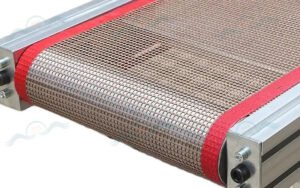
As the core substrate for high-temperature conveyor belts, Teflon (PTFE) high-temperature fabric is undergoing a revolution across three dimensions: material compounding, process upgrading, and functional integration. PTFE mesh fabric It is now fully adapted to the rigorous demands of continuous production lines in sectors such as lithium batteries, photovoltaics, semiconductors, and food/pharmaceuticals, becoming the preferred alternative to traditional rubber and metal belts in high-heat environments.
II. Key Innovative Technologies: Breaking Traditional Limitations
- Material Compounding Innovation
Nano-Modification: Doping with nanoparticles like graphene or boron nitride improves wear resistance (+40%) and thermal conductivity (+30%), adapting to higher line speeds and heat loads.
Gradient Functional Structure: A high-wear PTFE surface + thermal conductive middle layer + reinforced fiber base meets micron-level heat-pressing requirements.
Substrate Upgrades: Expansion from fiberglass to Kevlar and carbon fiber composites, increasing tensile strength by 2–3 times for heavy-duty conveying.
- Process Breakthroughs
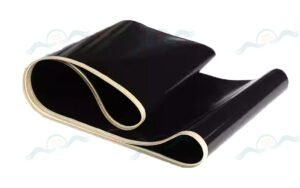
Seamless Integrated Molding: Circular weaving and integral sintering eliminate joint breakage risks, increasing lifespan by 50%.
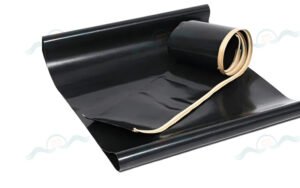
Precision Coating: Multi-stage impregnation and 360°C continuous sintering achieve coating uniformity of ±0.01mm, ensuring even heat distribution.
Functional Post-Treatment: Anti-static (surface resistance <10⁶Ω), specialized non-stick, and anti-bacterial treatments for electronics and food industries.
- Intelligent Integration
Embedded Sensors: Built-in modules for temperature, pressure, and wear monitoring enable predictive maintenance.
Data Interconnectivity: Integration with MES (Manufacturing Execution Systems) for real-time status feedback and optimized scheduling.
III. Solutions for Continuous Production Lines
- Line Adaptation Strategies
Modular Design: Custom shapes (straight, curved, inclined) to fit complex conveying paths.
Width Customization: Coverage from 50mm to 5000mm; ultra-wide models use double-weft weaving to prevent edge tearing.
Energy Optimization: Precise matching with drive rollers and tensioners reduces friction loss and energy consumption by 30%.
- Line Adaptation Strategies
Modular Design: Custom shapes (straight, curved, inclined) to fit complex conveying paths.
Width Customization: Coverage from 50mm to 5000mm; ultra-wide models use double-weft weaving to prevent edge tearing.
Energy Optimization: Precise matching with drive rollers and tensioners reduces friction loss and energy consumption by 30%.
- Continuous Operation Assurance
Simplified Maintenance: Self-cleaning surfaces reduce maintenance downtime by 80%.
Lifespan Extension: Utilization of pulley rollers at transitions to prevent tearing; improved hopper designs with buffer baffles.
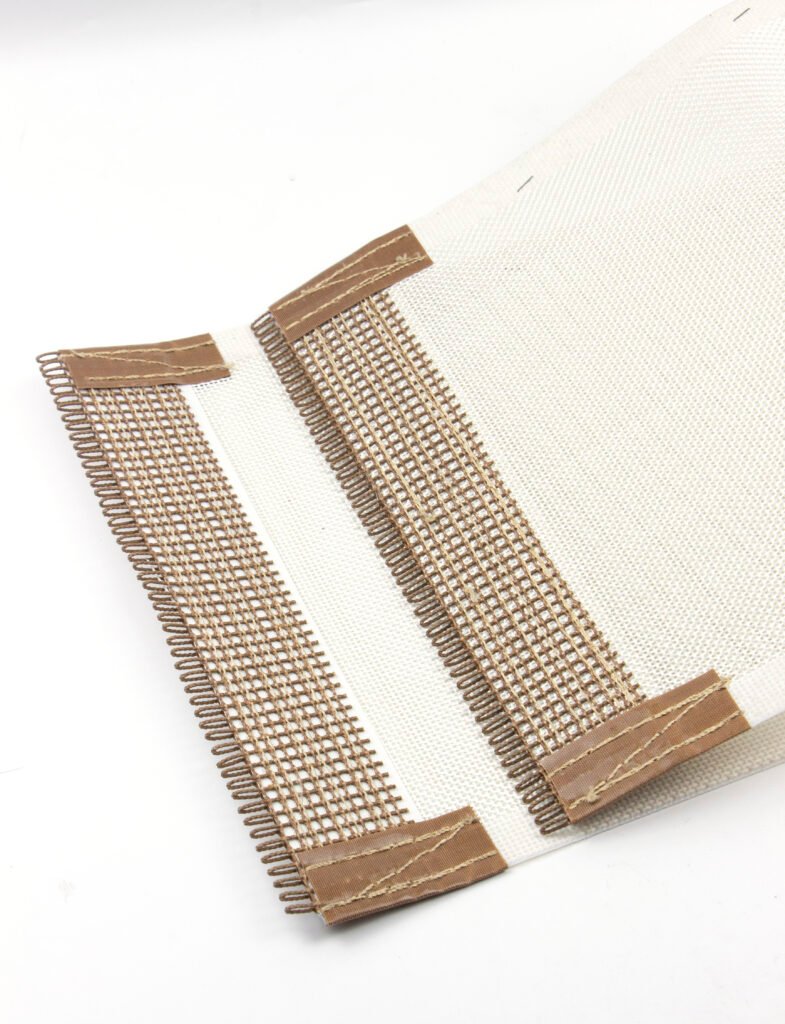
Rapid Change System: Specialized splicing tools reduce replacement time from 4 hours to 30 minutes.
IV. Value Proposition: Efficiency Multiplier
Total Life Cycle Cost Reduction: Service life of 1.5–2 years (vs. 6–12 months for rubber); maintenance costs drop by 70%.
Throughput Increase: 30% reduction in downtime and compatibility with line speeds up to 10m/s increase capacity by 25%.
Sustainability: Low friction reduces energy consumption; zero VOC emissions align with Carbon Neutrality strategies.
V. Future Trends
Ultra-High Temp Extension: Ceramic fiber composites to exceed 400°C for metallurgy and glass.
Micro-Miniaturization: Thickness reduction to 0.03mm for precision microchip packaging.
Self-Diagnostic AI: Integrated algorithms for autonomous fault prediction and belt adjustment.
Summary
PTFE high-temperature fabric has evolved from a mere “alternative” to a “core enabler” of continuous industrial production. Selecting the right belt requires balancing temperature, material traits, and line speed, prioritizing advanced solutions like seamless weaving and nano-modification to achieve a dual leap in efficiency and quality.