The Core Differences Between PTFE High-Temperature Fabric and Silicone Rubber Sheet
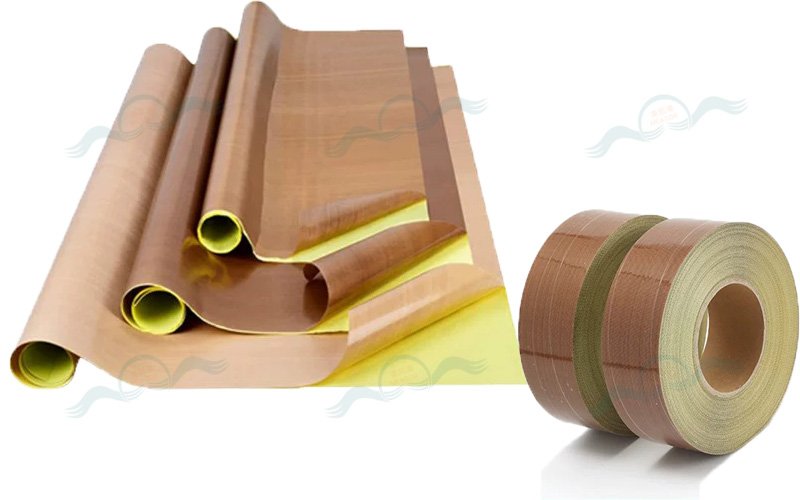
PTFE high-temperature fabric (polytetrafluoroethylene-coated fiberglass cloth) and silicone rubber sheet are both commonly used high-temperature resistant industrial materials, but they differ fundamentally in material composition, performance characteristics, and applicable scenarios. Selecting the right material for the right application significantly impacts production efficiency and cost.
Ⅰ. Material Composition & Structural Differences
| Dimension | PTFE High-Temperature Fabric | Silicone Rubber Sheet |
|---|---|---|
| Core Material | PTFE (polytetrafluoroethylene) coating + fiberglass cloth substrate | Silicone rubber (polydimethylsiloxane cross-linked network structure) |
| Manufacturing Process | Fiberglass cloth impregnated with PTFE emulsion; sintered at high temperature to form coating | Silicone rubber vulcanized and molded under heat and pressure |
| Material Form | Composite fabric (soft but tear-resistant) | Solid elastomeric sheet (flexible, elastic) |
| Thickness Range | 0.08–1.5 mm (generally thin) | 0.5–50 mm (can be made in thick sections) |
Ⅱ. Core Performance Comparison
1. Temperature Resistance
| Material | Long-Term Continuous Temperature | Short-Term Peak Temperature | Low-Temperature Limit |
|---|---|---|---|
| PTFE High-Temp Fabric | -196°C to 260°C | 300–350°C (30 min) | -196°C (remains flexible) |
| Silicone Rubber Sheet | -60°C to 200°C (standard) / -60°C to 230°C (high-temp grade) | 250°C (brief) | -60°C (standard) |
Key Difference: PTFE fabric has a broader temperature resistance range — particularly stronger in ultra-low-temperature applications and long-term continuous high-temperature use above 200°C.
2. Non-Stick Performance
| Material | Surface Energy | Non-Stick Performance | Anti-Adhesion Materials |
|---|---|---|---|
| PTFE High-Temp Fabric | Extremely low (18–22 mN/m) | Excellent — virtually nothing adheres | EVA, epoxy resin, rubber, food, adhesives |
| Silicone Rubber Sheet | Medium (22–26 mN/m) | Good — resists most general adhesion | General food and light adhesives |
Key Difference: PTFE fabric offers far superior non-stick performance — particularly in high-temperature + adhesive material application scenarios.
3. Chemical Corrosion Resistance
| Material | Acid Resistance | Alkali Resistance | Organic Solvent Resistance |
|---|---|---|---|
| PTFE High-Temp Fabric | Excellent (strong acid resistant) | Excellent (strong alkali resistant) | Excellent (nearly universal resistance) |
| Silicone Rubber Sheet | Medium (dilute acid only) | Weak (strong alkali causes swelling) | Weak (swells in ketones, esters) |
Key Difference: PTFE fabric has comprehensive chemical inertness — suitable for strong acid, strong alkali, and organic solvent environments.
4. Mechanical Properties
| Material | Tensile Strength | Elongation at Break | Compressibility | Tear Resistance |
|---|---|---|---|---|
| PTFE High-Temp Fabric | High (fiberglass reinforced: 2,000–4,000 N/50mm) | Low (≤ 5%) | Very low — rigid, minimal compression | Good |
| Silicone Rubber Sheet | Medium (4–10 MPa) | High (100–600%) | High — excellent elasticity and cushioning | Medium |
Key Difference: PTFE fabric excels in tensile strength and dimensional stability; silicone rubber excels in elasticity, cushioning, and compressibility.
5. Electrical Insulation
| Material | Volume Resistivity | Dielectric Strength | Dielectric Constant |
|---|---|---|---|
| PTFE High-Temp Fabric | 10¹⁶–10¹⁸ Ω·cm | > 20 kV/mm | 2.1–2.6 (extremely low) |
| Silicone Rubber Sheet | 10¹³–10¹⁵ Ω·cm | 15–20 kV/mm | 2.8–3.5 |
Key Difference: PTFE fabric has higher electrical insulation performance — particularly advantageous in high-frequency and high-voltage scenarios.
6. Surface Characteristics
| Material | Surface Smoothness | Self-Cleaning | Breathability |
|---|---|---|---|
| PTFE High-Temp Fabric | Very smooth (Ra ≤ 1.5 μm) | Excellent (rain/water beads off) | Has air permeability (mesh type) |
| Silicone Rubber Sheet | Medium roughness; can be textured | General | No breathability |
Ⅲ. Application Scenario Comparison
| Application | Preferred Material | Reason |
|---|---|---|
| PV laminator cushion fabric | PTFE high-temp fabric | Dimensional stability + non-stick to EVA + air permeability |
| Food baking tray liner | PTFE high-temp fabric | Non-stick + food-grade safety + 260°C heat resistance |
| Heat sealer / bag-making machine liner | PTFE high-temp fabric | High-temp non-stick + wear resistance + long service life |
| Chemical pipeline anti-corrosion liner | PTFE high-temp fabric | Strong acid/alkali resistance + high-temp corrosion resistance |
| Press machine buffer pad | Silicone rubber sheet | High compressibility + cushioning + elastic recovery |
| Mold sealing gasket | Silicone rubber sheet | Good elasticity sealing + compression set resistance |
| High-temperature oven door seal | Silicone rubber sheet | Good elasticity + moderate temperature resistance + cost advantage |
| Electrical insulation for high-frequency equipment | PTFE high-temp fabric | Ultra-low dielectric constant + high breakdown voltage |
Ⅳ. Cost & Service Life Comparison
| Dimension | PTFE High-Temp Fabric | Silicone Rubber Sheet |
|---|---|---|
| Unit Price | Higher (PTFE resin + fiberglass composite process) | Lower (silicone raw material is relatively economical) |
| Service Life | Long (8,000+ high-temp cycles) | Medium (prone to aging above 200°C; shorter service life) |
| Total Cost of Ownership | Lower (high initial cost but long life reduces replacement frequency) | Higher (lower initial cost but more frequent replacement above 200°C) |
Ⅴ. Summary: How to Choose
Select PTFE High-Temperature Fabric When:
- Operating temperature exceeds 200°C continuously
- Non-stick performance is the core requirement (adhesives, resins, EVA)
- Environments involve chemical corrosion (strong acids, strong alkalis, organic solvents)
- High electrical insulation performance is required
- Precise dimensional stability is required (PV lamination, precision hot press)
Select Silicone Rubber Sheet When:
- Operating temperature is below 200°C and elasticity/cushioning is needed
- Good compression sealing or buffering is required
- Cost is the primary consideration (short-term or low-frequency applications)
- Complex-profile sealing gaskets or pads requiring flexible conformability