What Is the Relationship Between the Weaving Density of PTFE High-Temperature Fabric and Its Performance?
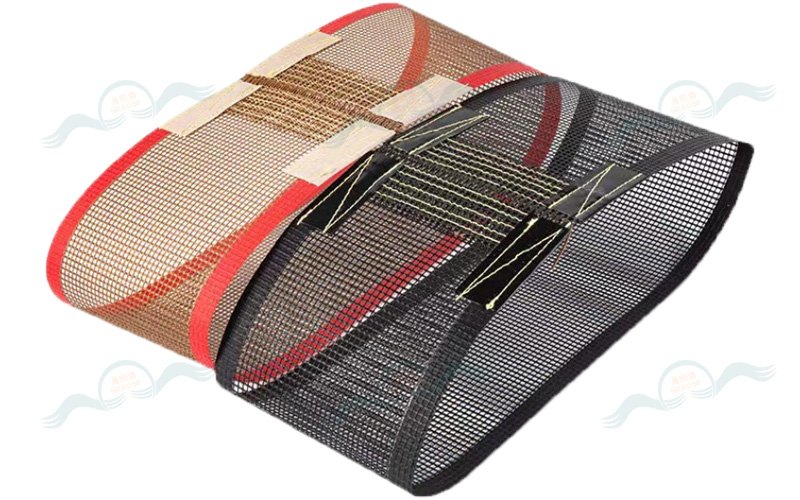
The weaving density of PTFE high-temperature fabric (expressed as threads per centimeter or threads per inch in the warp and weft directions) directly affects six core performance dimensions: tensile strength, dimensional stability, PTFE coating adhesion quality, air permeability, surface smoothness, and service life. It is one of the most critical structural parameters of the fabric.
Ⅰ. Weaving Density and Tensile Strength (Most Direct Mechanical Relationship)
Positive Correlation: Higher Density → Higher Tensile Strength
Weaving density determines the number of load-bearing fibers per unit width — the core factor in tensile strength:
| Weave Density Grade | Warp/Weft Thread Count (threads/cm) | Tensile Strength Range (N/50mm) | Applicable Load Level |
|---|---|---|---|
| Low Density | 4–6 / 3–5 | 500–900 | Light-duty liners, temporary gaskets |
| Medium Density | 7–10 / 6–8 | 1,000–2,000 | Food conveyor belts, baking tray liners |
| High Density | 11–15 / 9–12 | 2,500–4,000 | PV laminators, industrial conveyor belts |
| Ultra-High Density | > 15 / > 12 | > 4,000 | Heavy industrial conveyor belts, high-tension sealing |
Key Points:
- Warp direction (machine direction) thread count has a greater impact on tensile strength than weft direction — because belt tension in conveyor belt applications is primarily in the warp direction
- Each additional thread/cm in warp density increases tensile strength by approximately 150–200 N/50mm (varies by yarn specification)
Ⅱ. Weaving Density and Dimensional Stability (Temperature Resistance-Related)
High Density → Better Dimensional Stability at High Temperature
Under high-temperature conditions (200–260°C), fiberglass undergoes minor thermal expansion. High-density weave restricts fiber movement through tighter mutual constraints:
- High-density fabric: Thermal elongation rate ≤ 0.3% at 260°C; suitable for high-precision processes (PV lamination, precision hot press)
- Low-density fabric: Thermal elongation rate 0.5–1.5% at 260°C; not recommended for dimensional-accuracy-critical applications
Additionally, high-density weave improves bending fatigue resistance — reduces the risk of fiber displacement caused by repeated bending cycles.
Ⅲ. Weaving Density and PTFE Coating Adhesion Quality (Coating Performance Impact)
Optimal Density Window: 7–12 Threads/cm
Weaving density directly affects how well PTFE emulsion penetrates and adheres to the fiberglass skeleton:
- Too low density (< 5 threads/cm): Mesh apertures are too large — PTFE emulsion tends to flow through rather than adhere uniformly; coating coverage is insufficient and prone to pinholes; chemical resistance and non-stick durability are significantly reduced
- Optimal density (7–12 threads/cm): Mesh apertures of moderate size — PTFE emulsion fully infiltrates the fiber interstices; coating is dense and uniform; excellent adhesion; optimal coating performance
- Too high density (> 15 threads/cm): Mesh apertures are too small — PTFE emulsion cannot fully penetrate to the fiber core; coating remains on the surface with poor infiltration depth; the interface between fiberglass and PTFE becomes a potential delamination plane
Engineering Implication: Selecting appropriate weaving density is a prerequisite for optimizing PTFE coating quality — it is not simply “higher density is always better.”
Ⅳ. Weaving Density and Air Permeability (Important for Functional Products)
Negative Correlation: Higher Density → Lower Air Permeability
This is one of the most significant performance trade-offs in product design:
- Low-density / open-mesh fabric (4–6 threads/cm): High air permeability — 50–200 L/(m²·s); suitable for food drying conveyor belts and microwave drying (requires rapid moisture/vapor escape)
- Medium-density fabric (7–10 threads/cm): Moderate air permeability — 10–50 L/(m²·s); suitable for PV laminators (balances degassing efficiency with EVA penetration resistance)
- High-density fabric (11–15 threads/cm): Low air permeability — 1–10 L/(m²·s); closer to non-breathable structure; suitable for chemical liners and sealing gaskets (minimizes permeability to chemical media)
- Ultra-high-density fabric (> 15 threads/cm): Near-zero air permeability; suitable for insulation and sealing applications requiring vapor impermeability
Ⅴ. Weaving Density and Surface Smoothness (Affects Non-Stick Performance)
High Density → Smoother Surface → Better Non-Stick Performance
Weaving density affects the geometric profile of the fabric surface:
- Low-density fabric: Visible weave texture (interlace bumps) on the surface; after PTFE coating, the texture is partially preserved; surface roughness Ra = 2–5 μm; may leave imprint marks on materials during hot press processes
- High-density fabric: More uniform fiber distribution; surface texture is less pronounced; after PTFE coating, roughness Ra ≤ 1.5 μm; higher surface smoothness; better non-stick performance and release quality
- Special plain weave high-density: Using fine-diameter yarn with high thread count produces a fabric surface approaching near-flat topology; particularly suitable for food baking and PV module lamination requiring smooth surface finish
Ⅵ. Weaving Density and Service Life (Wear & Fatigue Resistance)
High Density → Longer Service Life (Generally)
- Wear resistance: High-density weave provides more fiber support per unit area — resists localized wear; even as the PTFE surface coating gradually wears, the dense fiber skeleton continues to provide mechanical support, delaying wear-through to the substrate
- Fatigue resistance: High-density weave distributes bending stress more uniformly across more fibers — reduces stress concentration at individual filaments; significantly improves bending fatigue life
- Anti-delamination: High-density weave provides greater mechanical interlocking surface area between fibers and PTFE coating — higher resistance to coating delamination under tension and thermal cycling
Quantified Reference: Compared to low-density fabric, high-density PTFE fabric typically extends service life by 40–80% under equivalent operating conditions.
Ⅶ. Summary: Weaving Density Selection Recommendations by Application Scenario
| Application Scenario | Recommended Warp Density | Key Performance Priority |
|---|---|---|
| Food drying conveyor belts | 5–7 threads/cm | Air permeability priority |
| Baking tray liners | 7–10 threads/cm | Balanced non-stick and moderate strength |
| PV laminator cushion fabric | 10–13 threads/cm | Balanced air permeability, strength, and surface smoothness |
| Industrial high-temp conveyor belts | 11–15 threads/cm | Tensile strength and service life priority |
| Chemical anti-corrosion liners | 12–16 threads/cm | Coating adhesion quality and chemical barrier priority |
| High-pressure sealing gaskets | > 15 threads/cm | Dimensional stability and impermeability priority |
Overall Summary
The weaving density of PTFE high-temperature fabric is a core structural parameter that simultaneously influences tensile strength, dimensional stability, coating quality, air permeability, surface smoothness, and service life. These performances are not all positively correlated with density — they exhibit trade-off relationships (e.g., higher density improves strength but reduces breathability). The optimal density should be selected based on the application’s primary performance priority rather than simply maximizing density. In practice, combining weaving density with yarn specification, coating thickness, and PTFE impregnation process allows comprehensive optimization of PTFE high-temperature fabric performance.