Fiberglass Mesh Conveyor Belts: Core Solutions for Industrial Thermal Processing
In demanding applications such as industrial thermal processing, food dehydration, and chemical conveyance, fiberglass mesh conveyor belts have become the premier replacement for traditional rubber and metal belts due to their exceptional high-temperature resistance, chemical inertness, and superior breathability.
I. Technical Principles: Composite Architecture for Performance Breakthroughs
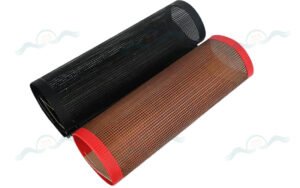
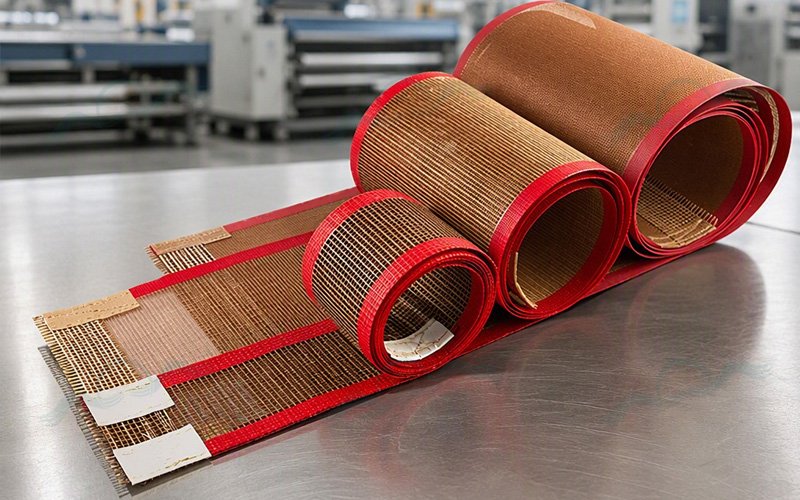
Fiberglass mesh conveyor belts utilize a high-strength woven fiberglass substrate impregnated with polytetrafluoroethylene (PTFE) resin, cured under high heat to form a uniform, open-mesh structure. Key engineering innovations include:
- Dual-Layer Reinforcement: The substrate is woven from E-glass or C-glass fiber yarns, with warp and weft tensile strengths reaching $136\times4\text{ to }136\times7\text{ tex}$ to ensure load-bearing stability. The PTFE coating thickness ranges from $0.05\text{ to }0.2\text{ mm}$, providing non-stick performance, chemical resistance, and self-cleaning capabilities.
- Open-Mesh Breathable Design: Standard mesh sizes range from $0.5\times1\text{ mm}$ to $10\times10\text{ mm}$, boosting convective hot air efficiency by $30\%$ and cutting energy consumption by $20\%$. A porosity ratio of $40\%\text{ to }60\%$ perfectly balances breathability with structural tensile strength.
II. Performance Parameters: Hardcore Metrics Exceeding Industry Standards
| Metric | Parameter Range | Comparative Industry Advantage |
| Operating Temperature | $-196^\circ\text{C}$ to $300^\circ\text{C}$ (Continuous duty) | High-temp threshold exceeds standard rubber belts by $200^\circ\text{C}$ |
| Tensile Strength | $310\text{–}900\text{ N/cm}$ ($4\times4\text{ mm}$ spec) | $60\%$ lighter than metal mesh with $3\times$ higher strength |
| Corrosion Resistance | Withstands aqua regia, concentrated sulfuric acid, and sodium hydroxide | SGS certified, extending operational lifespan up to $5\times$ over traditional materials |
| Air Permeability | $15\text{–}30\text{ m}^3/(\text{m}^2\cdot\text{h})$ | Accelerates drying efficiency by $25\%$ while cutting energy use by $18\%$ |
| Min. Pulley Diameter | $20\text{ mm}$ (Double-weft construction) | Perfectly suits high-frequency start-stop equipment, minimizing fatigue fracture risks |
III. Application Scenarios: Covering Core Industrial Sectors
- Textile Printing, Dyeing & Non-Wovens
- Applications: Print drying, fabric shrinkage and heat-setting, non-woven thermal bonding.
- Case Study: A textile plant utilizing $4\times4\text{ mm}$ mesh belts operated continuously at $250^\circ\text{C}$ for $200$ days without breakage, reducing energy consumption by $15\%$.
- Food Processing
- Applications: Baking conveyor lines, freezing/thawing tunnels, heat-shrink packaging.
- Compliance: FDA 21 CFR 177.1550 certified, odorless release, cutting cleaning downtime to $1/5$ of traditional metal or rubber belts.
- Electronics Manufacturing
- Applications: Lead-free reflow soldering, PCB conveyance, SMT assembly lines.
- Case Study: A semiconductor facility utilizing Kevlar-reinforced mesh belts increased production yield to $99.95\%$ while reducing electrostatic adsorption defects by $70\%$.
- Chemical & Environmental Protection
- Applications: Flue gas desulfurization, municipal waste incinerator linings, reagent transport.
- Advantages: Resists aqua regia corrosion, delivering a lifespan exceeding $3$ years in aggressive acid-alkaline environments and lowering maintenance overhead by $60\%$.
IV. Selection Guide: Three Dimensions for Precise Process Matching
- Thermal Requirements
- Low-Temperature Range ($-196^\circ\text{C}$ to $100^\circ\text{C}$): Choose $0.5\text{ mm}$ thickness base grade, such as $1\times1\text{ mm}$ mesh.
- High-Temperature Range ($200^\circ\text{C}$ to $300^\circ\text{C}$): Choose Kevlar-reinforced variants, such as $4\times4\text{ mm}$ specifications with tensile strengths up to $895\text{ N/cm}$.
- Load Specifications
- Light-Duty (e.g., Food Packaging): Select $370\text{ g/m}^2$ standard base models ($310\text{ N/cm}$ tensile strength).
- Heavy-Duty (e.g., Chemical Transport): Select $600\text{ g/m}^2$ Kevlar-reinforced models ($895\text{ N/cm}$ tensile strength).
- Process Adaptation
- High-Frequency Start-Stop Equipment: Use double-weft construction with a $20\text{ mm}$ minimum pulley diameter, withstanding over $10^6$ bending fatigue cycles.
- High-Precision Conveyance: Select PTFE skived-film edge binding to maintain a surface flatness error of $<0.1\text{ mm}$.
V. Industry Trends: Merging Customization with Smart Integration
- Functional Integration: Anti-static and antimicrobial coating options tailored for the pharmaceutical and electronics industries.
- Extra-Wide Customization: Supporting $4200\text{ mm}$ ultra-wide double-weft configurations for massive industrial drying lines.
- Smart Monitoring: Embedded thermal sensors for real-time operational health tracking.
The video below shows the operational setup, drying workflow, and physical characteristics of industrial mesh conveyor belts in high-temperature environments.