Advantages of PTFE Mesh Belts in Industrial Applications
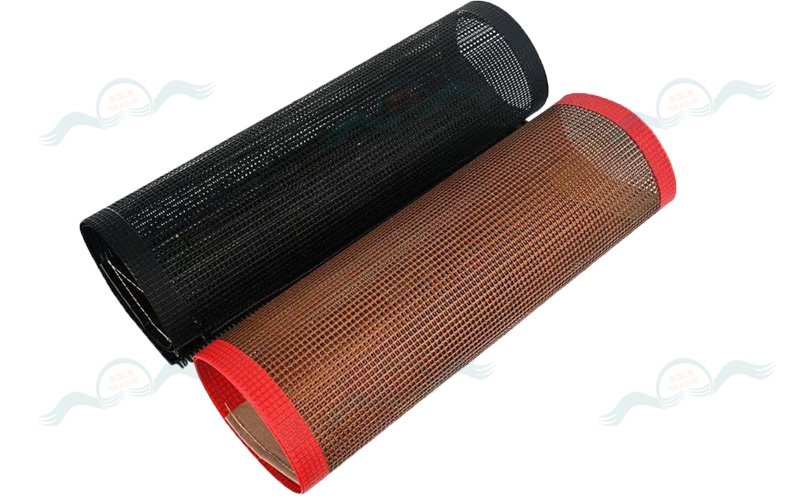
PTFE mesh belts (also called Teflon mesh belts) are composites made by impregnating high-performance fiberglass mesh fabric with PTFE emulsion. Their core advantages are:
- Extreme temperature adaptability
- Outstanding corrosion resistance
- Non-stick, easy-to-clean surface
- High strength and dimensional stability
- Air permeability and energy savings
- Environmental and safety performance
- Customization capability
Ⅰ. Detailed Analysis
1. Extreme temperature adaptability
- Range: long-term use from -196°C to 300°C; short-term, only 0.6% weight loss at 350°C
- Low temperature: remains flexible and crack-free at -180°C
- Applications: food (high-temperature baking of bread and pastries, frozen food processing); chemical and electronics (high-temperature reactors, electronic component drying, microwave enzyme-deactivation equipment); cold environments (frozen meat handling, low-temperature storage conveying)
2. Outstanding corrosion resistance
- Chemical stability: resists strong acids (sulfuric, hydrochloric), strong alkalis (sodium hydroxide), aqua regia and many organic solvents, with virtually no reaction to chemical agents
- Applications: chemical (corrosive chemical conveying, acid/alkali filtration); pharmaceutical (drug liquid drying, conveying in sterile environments); electronics (circuit board cleaning, chemical plating)
3. Non-stick and easy cleaning
- Surface: low friction coefficient (0.05–0.1), smooth, virtually nothing adheres (flour, oil, resin); pastes and coatings are easily removed, reducing cleaning time
- Applications: food (no dough or syrup residue); printing and packaging (prevents ink and glue adhesion); textile dyeing (easy cleanup after print drying, less downtime)
4. High strength and dimensional stability
- Mechanical: elongation under 5%; high tensile strength (e.g., 4×4 mm fiberglass grade reaches 3200/2700 N/5 cm); flex-fatigue resistant for small-roller equipment without long-term deformation
- Applications: textile (print drying and fabric pre-shrinking conveyors); high-precision manufacturing (electronic components, precision parts); heavy industry (ore screening, building materials)
5. Air permeability and energy savings
- Design: mesh structures (1×1 mm, 4×4 mm) improve permeability and reduce heat loss, lowering drying energy use and raising efficiency
- Applications: drying equipment (microwave/infrared drying of fabrics and food); high-frequency equipment (rapid plastics drying); packaging (heat shrink, moisture-containing items)
6. Environmental and safety performance
- Material safety: FDA certified, non-toxic, odorless, food-grade; releases no harmful gases and can contact food directly
- Applications: food contact (meat frying, baking liners, frozen food); pharmaceutical packaging (sterile-environment conveying); environmental (chemical wastewater treatment, cleanrooms)
7. Customization
- Options: mesh size (1×1 mm to 10×10 mm), material (fiberglass/Kevlar), thickness and coatings (PVC, TPU, etc.); special properties such as flame retardancy or anti-static
- Applications: special environments (high radiation, high wear); equipment fit (various widths and lengths); industry-specific (e.g., high-tensile mesh belts for wind turbine blade manufacturing)
Ⅱ. Typical Application Cases
- Food baking equipment: replaces stainless steel mesh, avoiding rust and contamination while improving baking efficiency; frozen food stays flexible at low temperature for stable conveying
- Textile printing/dyeing: no deformation at high temperature, ensuring print accuracy and fewer rejects; breathable mesh speeds fabric pre-shrink drying and cuts energy use
- Chemical and pharmaceutical: acid/alkali resistance extends equipment life and cuts maintenance; non-toxic material keeps drug liquid drying pure and GMP-compliant
- Electronics: heat-resistant, non-stick belts avoid solder residue on circuit board drying; high strength and stability protect precision component conveying
- Environmental and energy: high-tensile mesh belts solve sintering adhesion of fiberglass cloth in wind power; as solar lamination fabric they preserve module sealing and generation efficiency
With heat resistance, corrosion resistance, non-stick performance, strength, safety and customization, PTFE mesh belts are a key material across food processing, textile dyeing, chemical and electronics industries, raising efficiency, cutting maintenance cost and serving as the preferred solution for high-temperature, corrosive and high-cleanliness conditions.