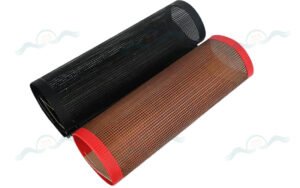
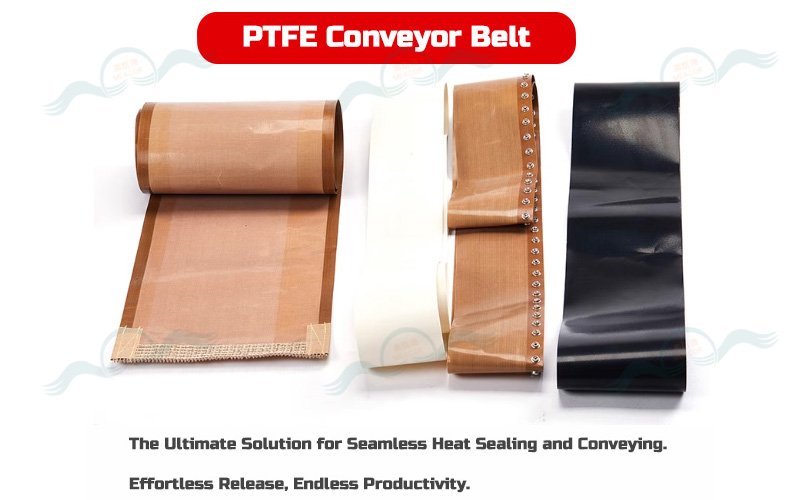
Key Considerations for Selecting PTFE High-Temperature Conveyor Belts in Food Baking Equipment
When selecting PTFE (Teflon) high-temperature conveyor belts for food baking equipment, it is essential to evaluate the following key parameters to ensure machine performance, food safety, and production efficiency:
1. Thermal Performance Matching
- Temperature Range Verification: Ensure the belt’s operating temperature covers the peak oven temperature (typically $180^\circ\text{C}$ to $280^\circ\text{C}$). PTFE substrates withstand $260^\circ\text{C}$ continuously and up to $300^\circ\text{C}$ intermittently; actual operating conditions must not exceed these thresholds.
- Thermal Stability Testing: Verify via supplier-provided TGA (Thermogravimetric Analysis) reports that the belt does not deform or release hazardous substances under high heat (per FDA standards).
2. Food Contact Safety
- Regulatory Compliance: Conveyor belt materials must comply with food-contact regulations such as FDA 21 CFR 177.1550 (US) and EU 10/2011 (European Union) to guarantee non-toxicity and zero chemical migration.
- Surface Treatment Verification: Confirm whether the belt undergoes food-grade lubrication treatment (e.g., food-grade silicone oil) to prevent product contamination from non-food-grade additives.
3. Structural & Design Compatibility
- Splice / Joint Selection:
- Spiral Joint: Recommended for precision baking lines (e.g., tunnel ovens). Vibration-resistant and scratch-free, ideal for fragile baked goods (e.g., biscuits/crackers).
- Bull-Nose Soft Joint: Suitable for low-temperature, light-duty zones (e.g., cooling conveyors), though regular inspection for thermal aging is required.
- Avoid Steel Clipper Fasteners: Rigid metal fasteners easily scratch food surfaces (such as bread or cakes) and tend to loosen under high heat.
- Mesh Aperture Optimization: Select mesh opening sizes according to the baked product:
- Fine Mesh ($1\times1\text{ mm}$): Ideal for small granular foods (such as nuts and crumbs) to prevent drop-through.
- Large Mesh ($5\times5\text{ mm}$): Enhances airflow and accelerates hot air circulation, suited for flat products like cookies and chips.
4. Cleanability & Maintenance
- Surface Cleanability: PTFE’s low friction and non-stick properties minimize residue buildup, but verify compatibility with CIP (Clean-in-Place) systems or high-pressure water washdowns.
- White Belts vs. Solid Belts: White belts facilitate visual hygiene inspections, though periodic checks for yellowing (pigment migration under high heat) are necessary. Non-porous solid belts reduce bacterial harborage risks, though lower breathability requires balancing hygiene against drying efficiency.
- Joint Sealing: Spiral joints offer gap-free construction that prevents liquid ingress during washdowns, minimizing microbial growth risks.
5. Mechanical Performance Compatibility
- Tensile Strength & Elongation:
- Light-Duty Applications (e.g., Biscuits): Select standard PTFE mesh belts (tensile strength $\ge 300\text{ N/cm}$).
- Heavy-Duty Applications (e.g., Frozen Dough): Select Kevlar-reinforced composite belts (tensile strength $\ge 900\text{ N/cm}$) to prevent snapping.
- Low Elongation: PTFE features an elongation coefficient $< 0.5\%$, making it suitable for small-diameter rollers (e.g., pulley diameter $< 50\text{ mm}$).
- Flex-Fatigue Endurance: For equipment with frequent start-stop cycles (e.g., sorting lines), verify flex-fatigue endurance (typically $> 100,000$ cycles) to prevent premature cracking.
6. Environmental Adaptability
- Humidity & Corrosion Resistance: High-humidity bakery environments require confirmation of hydrolysis resistance (while PTFE itself is waterproof, adhesive layers may be affected). If steam cleaning is utilized, specify moisture- and heat-aging resistant adhesive formulations.
- Static Control: Dry snacks (such as potato chips) readily generate static electricity; choose anti-static coated belts (surface resistance $< 10^9\,\Omega$) to prevent dust attraction or product sticking.
7. Customization Requirements
- Width & Length: Customize dimensions precisely to the oven width (extra-wide widths available up to $4200\text{ mm}$) to avoid edge curling from oversized belts or tracking deviation from undersized belts.
- Edge Reinforcement Materials: Use PTFE film edging (rated up to $300^\circ\text{C}$) for high-temperature baking zones, and silicone edging (rated $-40^\circ\text{C}$ to $220^\circ\text{C}$) for lower-temperature zones.
- Breathability Engineering: Open-mesh structures reduce heat loss and improve drying efficiency (cutting tunnel oven energy consumption by $10\%\text{–}15\%$), balanced against product support requirements.
8. Supplier Qualification & Cost Evaluation
- Supplier Credentials: Partner with ISO 9001-certified manufacturers capable of supplying MSDS (Material Safety Data Sheets) and food-contact compliance certificates.
- Total Cost of Ownership (TCO): While PTFE conveyor belts carry a higher initial cost (approx. $\text{RMB } 200\text{–}500/\text{m}^2$), their extended service life (typically $3\text{–}5$ years) lowers total operational costs compared to frequent replacements of cheaper belts.
- Spare Parts Inventory: Maintain spare belt lengths for custom specifications to prevent costly production downtime during maintenance.
Selection Decision Workflow
- Operating Condition Analysis: Define oven temperatures, food types, sanitation protocols, and load parameters.
- Material Verification: Request third-party test reports (thermal stability, food-contact safety, tensile strength).
- Structural Matching: Select splice types and mesh opening sizes based on food characteristics.
- Supplier Evaluation: Review industry case studies, after-sales support, and customization capabilities.
- Pilot Testing: Conduct small-batch trials to validate cleaning efficiency and product breakage rates.
- Ongoing Monitoring: Regularly inspect belt wear and splice integrity to optimize preventive maintenance schedules.
Selecting PTFE high-temperature conveyor belts for food baking equipment requires balancing four core pillars: thermal endurance, food safety, structural compatibility, and ease of cleaning. A systematic selection approach minimizes contamination risks, boosts throughput, and optimizes total lifecycle costs.