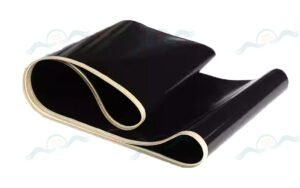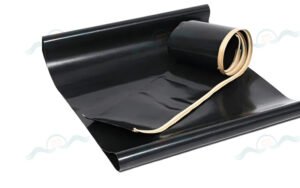
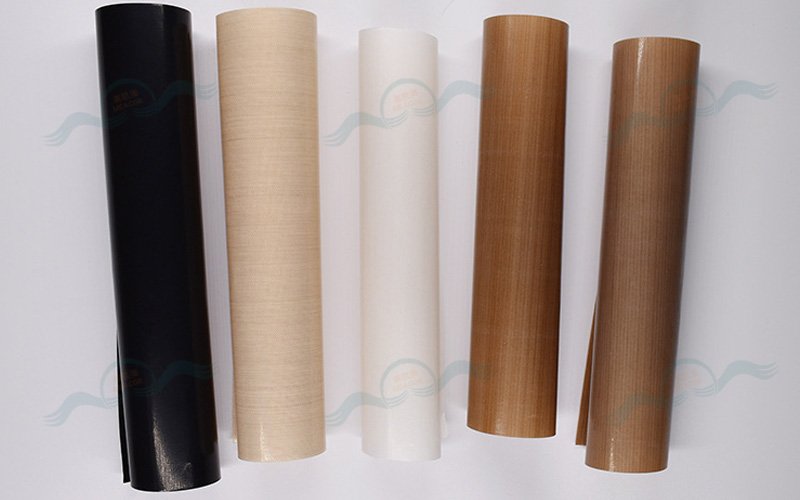
Does PTFE High-Temperature Fabric Contain Fiberglass?
Most standard PTFE high-temperature fabric contains fiberglass — but not all types do. The determining factor is the substrate material. Products can be divided into two categories:
Ⅰ. PTFE High-Temperature Fabric Containing Fiberglass (Mainstream Type)
This is the most common type of PTFE high-temperature fabric on the market. Fiberglass serves as the core structural skeleton and plays a critical role:
Material Structure:
Fiberglass cloth or fiberglass mesh serves as the substrate (structural support layer), with a polytetrafluoroethylene (PTFE) coating applied to the surface through impregnation or coating processes — forming a composite structure of “fiberglass substrate + PTFE coating.”
Why Is Fiberglass Added?
PTFE itself offers excellent heat resistance, non-stick performance, and chemical corrosion resistance — but pure PTFE film has low mechanical strength, tears easily, and has poor dimensional stability (prone to shrinkage and deformation at high temperatures). Fiberglass complements these weaknesses perfectly: it withstands high temperatures (long-term rating of 260°C, matching PTFE), offers high tensile strength, rigidity, and dimensional stability — allowing the composite fabric to retain PTFE’s non-stick and corrosion-resistant properties while also being cuttable, sewable, and capable of withstanding tension (for applications such as conveyor belts, baking tray liners, and sealing machine gaskets).
Common Applications:
Industrial conveyor belts, food-grade baking tray liners, high-temperature pipeline wrapping, welding protection fabric, printing machine blade gaskets — virtually any scenario requiring a combination of high-temperature resistance, non-stick performance, and structural strength uses this fiberglass-reinforced PTFE fabric.
Ⅱ. PTFE High-Temperature Fabric Without Fiberglass (Specialty Type)
These products are made from pure PTFE material with no fiberglass or other fiber reinforcement:
Material Structure:
Pure PTFE film or thin fabric produced from PTFE resin through calendering, extrusion, or similar processes — contains no reinforcing fibers whatsoever.
Characteristics:
Ultimate non-stick performance and superior chemical corrosion resistance, but extremely low mechanical strength, highly prone to damage, and poor dimensional stability. Thickness is typically very thin (generally 0.01–0.1 mm); cannot withstand tension or friction.
Common Applications:
Suitable only for scenarios where structural strength is not required and only short-term non-stick or anti-corrosion isolation is needed — such as laboratory chemical reaction vessel liners and temporary high-temperature sealing gaskets (non-load-bearing). Rarely used in everyday industrial or consumer applications.
Additionally, a small number of non-fiberglass-reinforced PTFE fabrics use aramid fiber or carbon fiber as the substrate — but these products carry extremely high costs, are limited to aerospace and high-end electronics applications, and are not standard commercial products.
Summary
- Industrial and food-grade PTFE high-temperature fabric encountered in everyday use is fiberglass-reinforced (> 99% of the market), with fiberglass serving as the reinforcing substrate
- Only pure PTFE film/thin fabric in specialized scenarios contains no fiberglass — but its practical versatility is very limited
To confirm whether a specific product contains fiberglass, check the product specifications (typically labeled as “fiberglass-reinforced PTFE fabric” or “pure PTFE film”), or use a simple hand feel assessment: fiberglass-reinforced PTFE fabric feels stiff, resilient, and tear-resistant; pure PTFE fabric feels soft and fragile — it deforms or tears easily with minimal force.