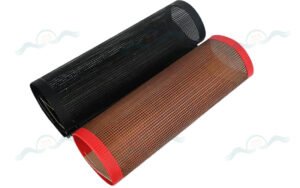

PTFE Conveyor Belt Splicing Methods
All PTFE conveyor belts must be joined into an endless loop before use. The quality of the splice directly affects belt service life and whether the conveyor line runs smoothly. The methods below are easy to master, economical, and produce stable, long-lasting joints.
Three splicing methods are commonly used for PTFE conveyor belts:
Ⅰ. Lap Splice (Overlap Method)
Lay the PTFE belt flat on the dryer and align the two ends, leaving an overlap of about 6 cm. Place a layer of high-temperature adhesive between the overlapped ends, with a small wooden board underneath. Heat a high-temperature electric iron to 400°C and move it slowly back and forth over the belt for several seconds. Once the splice has cooled, the belt is ready for use.
A skived lap splice (thinned overlap) is also available. Its advantage is a smoother belt surface; its drawback is higher technical skill requirements.
Ⅱ. Butt Splice (Butt-Joint Method)
First prepare the lap joint as above, then use a knife to cut a straight line through the overlap and remove the excess material, so the joint becomes flat and smooth. Place high-temperature adhesive and a correspondingly sized belt strip underneath, then bond using the same procedure.
Ⅲ. Fastener Splice (Mechanical Joint Method)
Use dedicated conveyor belt fasteners, mainly bull-nose (lace) joints or wall-type joints. The method is simple and replacement is easy, making it suitable for splicing all types of PTFE mesh conveyor belts.